
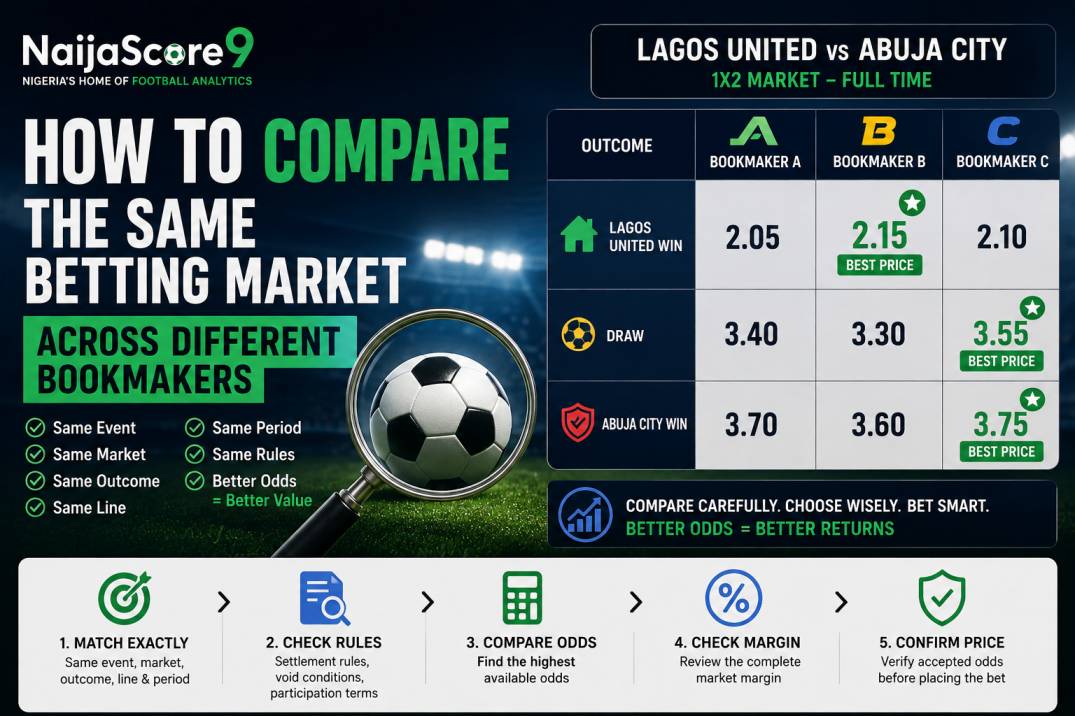
One bookmaker offers a football selection at odds of 2.05. Another displays 2.15, while a third offers 2.20.
The largest number appears to be the obvious choice.
However, the prices are comparable only when they apply to the same event, outcome, market, betting line, match period and settlement conditions.
A home team to win after 90 minutes is not the same market as the same team to qualify after extra time or penalties. Over 2.5 Goals is not directly comparable with Over 2.25 Goals. A player to score at any time may also be settled differently when the player starts on the bench or does not participate.
Correct bookmaker comparison therefore involves two stages:
- Confirm that every price refers to exactly the same betting outcome.
- Compare the odds, market margin and practical conditions attached to that outcome.
The central principle is:
A higher price is better only when everything else is genuinely equal.
What Does Comparing Betting Markets Mean?
Comparing betting markets means examining prices offered by multiple bookmakers for the same possible outcome.
For example, suppose three Nigerian betting sites offer the following prices for Lagos United to beat Abuja City:
| Bookmaker | Lagos United win |
| Bookmaker A | 2.05 |
| Bookmaker B | 2.15 |
| Bookmaker C | 2.10 |
When all three prices refer to the same full-time 1X2 home-win market, Bookmaker B offers the highest price.
A ₦10,000 stake would produce:
| Bookmaker | Odds | Total potential return | Potential profit |
| Bookmaker A | 2.05 | ₦20,500 | ₦10,500 |
| Bookmaker B | 2.15 | ₦21,500 | ₦11,500 |
| Bookmaker C | 2.10 | ₦21,000 | ₦11,000 |
Bookmaker B would return ₦1,000 more than Bookmaker A if the selection won.
The probability of the match outcome has not changed between the sites. The difference comes from the price accepted.
This practice is sometimes called:
- odds comparison;
- price comparison;
- bookmaker comparison;
- line shopping;
- shopping for the best odds.
Why Comparing Football Odds Matters?
Decimal odds determine both the potential return and the raw break-even probability.
The relationship is:
Implied probability = 1 ÷ decimal odds
Odds of 2.05 imply:
1 ÷ 2.05 = 48.78%
Odds of 2.15 imply:
1 ÷ 2.15 = 46.51%
A bettor accepting 2.15 instead of 2.05 receives a larger potential return and requires a lower long-term success rate to break even before costs.
Betting odds represent both a potential payout and an implied probability, while the combined probabilities across a full bookmaker market commonly include a margin above 100%.
The NaijaScore9 implied probability calculator can convert each decimal price into its raw break-even percentage.
When odds are displayed in fractional or American format, use the odds converter before comparing them.
The Seven Details That Must Match
Before deciding that one bookmaker offers better odds, verify the following seven elements.
| Comparison point | What must match |
| Event | Same fixture and participants |
| Market | Same type of selection |
| Outcome | Same possible result |
| Betting line | Same goals, handicap or statistical threshold |
| Match period | Same full-time, half, quarter or extra-time period |
| Settlement rules | Same treatment of participation, postponements and other conditions |
| Comparison time | Prices recorded at approximately the same moment |
A difference in any one of these elements can make the prices unsuitable for direct comparison.
1. Confirm the Same Fixture
Start by checking that the bookmakers list the same:
- teams;
- competition;
- fixture date;
- kick-off time;
- home and away designation;
- age group;
- gender category;
- reserve or senior team.
This matters because clubs can have senior, youth, women’s and reserve teams with similar names.
Do not compare a price for:
Lagos United
with a market for:
Lagos United U21
or:
Lagos United Women
Official sportsbook rules can void markets when the listed fixture details do not match the official event, including differences involving reserve teams, age groups or gender categories.
When comparing less familiar leagues, confirm the competition and participants before checking the odds.
2. Confirm the Same Market
Two selections can use the same team name while representing different betting markets.
Consider these examples:
- Lagos United to win after 90 minutes;
- Lagos United draw no bet;
- Lagos United to qualify;
- Lagos United to win either half;
- Lagos United to lift the trophy.
All five selections support Lagos United, but they do not have the same conditions or probabilities.
Match Result vs Team to Qualify
A standard football 1X2 market usually contains:
- home win;
- draw;
- away win.
It is commonly settled using the result after 90 minutes plus stoppage time. Extra time and penalties are normally excluded unless the market states otherwise.
A “team to qualify” market generally includes extra time and penalties when necessary. Betfair’s official football rules explicitly distinguish 90-minute markets from “to qualify” and trophy markets that include later stages of the match.
Therefore, these prices are not directly comparable:
| Market | Example price |
| Lagos United to win in 90 minutes | 2.40 |
| Lagos United to qualify | 1.75 |
The 2.40 price requires Lagos United to lead at the end of normal time. The 1.75 price can win after extra time or penalties, depending on the stated rules.
The higher number does not represent a better price for the same event. It represents a more demanding outcome.
Match Result vs Draw No Bet
In a draw-no-bet market:
- the selected team wins: the selection wins;
- the match is drawn: the stake is normally returned;
- the selected team loses: the selection loses.
In a standard 1X2 market, a draw causes a home-win or away-win selection to lose.
The two markets therefore require different probabilities and should not be compared as identical options.
Double Chance vs Moneyline
Double chance combines two 1X2 outcomes:
- home or draw;
- home or away;
- draw or away.
A double-chance price should not be compared with a standard match-result price because the selection covers more than one possible result.
3. Confirm the Same Betting Line
The market name alone is not enough. The numerical line must also match.
Goals Markets
These are different markets:
- Over 1.5 Goals;
- Over 2.0 Goals;
- Over 2.25 Goals;
- Over 2.5 Goals;
- Over 3.5 Goals.
Suppose:
| Bookmaker | Market | Odds |
| Bookmaker A | Over 2.5 Goals | 1.90 |
| Bookmaker B | Over 2.25 Goals | 1.78 |
Bookmaker A displays the higher price, but the selections are not identical.
Over 2.25 is an Asian total that can divide the stake between two nearby lines. Over 2.5 has only a win-or-loss settlement under ordinary conditions.
For a direct comparison, all bookmakers must show Over 2.5 Goals.
Handicap Markets
These are also different:
- Lagos United −0.25;
- Lagos United −0.5;
- Lagos United −0.75;
- Lagos United −1.0;
- Lagos United −1.5.
A team at −0.5 must win the match for the selection to succeed.
A team at −1.0 may return the stake if it wins by exactly one goal, depending on the standard Asian-handicap settlement.
The prices cannot be ranked until the lines are aligned.
Player Markets
The threshold must match in markets such as:
- player Over 0.5 shots on target;
- player Over 1.5 shots on target;
- player Over 2.5 total shots;
- player to score at any time;
- player to score first.
A price of 1.85 for two or more shots is not a better version of 1.70 for one or more shots. The higher threshold is harder to achieve.
4. Confirm the Same Match Period
Football markets can apply to different periods:
- full match;
- first half;
- second half;
- first 10 minutes;
- extra time only;
- penalty shootout;
- a specified interval.
For example:
| Market | What it covers |
| Full-time Over 2.5 Goals | Normal time plus stoppage time |
| First-half Over 0.5 Goals | First half plus first-half stoppage time |
| Extra-time Over 0.5 Goals | Extra-time period only |
| Team to qualify | May include extra time and penalties |
Official football rules generally settle standard markets on 90 minutes plus stoppage time, excluding extra time and penalties unless the specific market says otherwise.
Always read the market heading and information icon before treating two prices as equivalent.
5. Compare Settlement Rules
Two bookmakers can display similar market names but apply different settlement rules.
This is particularly important for:
- player goalscorer markets;
- shots and shots-on-target markets;
- player cards;
- assists;
- postponed matches;
- abandoned matches;
- venue changes;
- dead heats;
- non-participating players.
Player Participation Rules
Suppose two bookmakers offer odds on a player to record Over 0.5 shots on target.
Bookmaker A may require the player to start for the selection to stand.
Bookmaker B may treat the selection as active if the player appears at any stage.
These conditions materially change the selection.
Official sportsbook rules demonstrate that participation requirements can vary by market. Betfair lists specific markets where players must start, while some other football markets treat any participation as sufficient. Bet365’s player-statistics rules also specify start requirements for certain markets.
Before comparing player odds, determine what happens when the player:
- starts;
- enters as a substitute;
- remains unused;
- is substituted early;
- participates only in extra time.
Own Goals
Goalscorer markets commonly exclude own goals, but users should still verify the operator’s rule.
A defender credited with an own goal has not necessarily won a first-goalscorer selection. Betfair’s official football rules state that own goals are not counted in specified goalscorer markets.
Official Data Providers
Player-statistics markets may be settled using data from an official provider such as Opta.
A shot shown by a television graphic or another statistics website may not match the provider used by the bookmaker. Betfair and Bet365 both identify official data sources for particular football-statistics markets.
When comparing player props, check:
- which data provider settles the market;
- how the statistic is defined;
- whether later corrections are recognised;
- whether the player must start.
Abandoned or Postponed Matches
Bookmakers can apply different time limits and settlement conditions to postponed or abandoned events.
Some markets may be void unless the outcome has already been unconditionally determined. Official sportsbook rules contain specific provisions for abandoned matches and markets whose results are already known.
The displayed odds do not reveal these conditions. They must be checked in the rules.
6. Compare Prices at the Same Time
Football odds can move before kick-off because of:
- team news;
- injuries;
- starting line-ups;
- betting activity;
- market liquidity;
- bookmaker adjustments.
A price recorded at 9:00 a.m. should not be presented as a direct current comparison with another price checked at 2:00 p.m.
Suppose:
| Time | Bookmaker A | Bookmaker B |
| 10:00 a.m. | 2.20 | 2.18 |
| 2:00 p.m. | 2.05 | 2.12 |
| 5:00 p.m. | 1.95 | 1.98 |
Saying that Bookmaker A offers 2.20 while Bookmaker B offers 1.98 would be misleading if the two figures were captured seven hours apart.
Our guide to why football odds move before kick-off explains how information and market activity can alter pre-match prices.
For a reliable comparison:
- open the same market at each bookmaker;
- refresh the pages;
- record the prices within a short interval;
- check that the odds remain available;
- confirm the accepted price on the final bet slip.
7. Compare the Accepted Price, Not Only the Displayed Price
A bookmaker page may display one price, but the market can move before the selection is confirmed.
For example:
- displayed price: 2.20;
- price after adding to bet slip: 2.15;
- accepted price: 2.10.
The relevant comparison is the price actually accepted.
Before confirming any selection:
- check the current bet-slip odds;
- review whether odds changes are accepted automatically;
- verify the stake;
- review the estimated return;
- retain the confirmation record.
A higher price is useful only when it can actually be accepted for the intended stake.
A Worked 1X2 Bookmaker Comparison
Consider the same fictional match across three bookmakers.
Available Prices
| Outcome | Bookmaker A | Bookmaker B | Bookmaker C |
| Lagos United | 2.05 | 2.15 | 2.10 |
| Draw | 3.40 | 3.30 | 3.55 |
| Abuja City | 3.70 | 3.60 | 3.75 |
All prices refer to the same:
- fixture;
- full-time 1X2 market;
- 90-minute period;
- settlement conditions;
- comparison time.
Best Price for Each Outcome
| Outcome | Best available price | Bookmaker |
| Lagos United | 2.15 | B |
| Draw | 3.55 | C |
| Abuja City | 3.75 | C |
Bookmaker B offers the best home-win price.
Bookmaker C offers the best draw and away-win prices.
No single operator provides the highest price for every possible result.
How the Price Difference Changes Potential Returns?
Assume a ₦20,000 stake on Lagos United.
| Bookmaker | Odds | Total return | Potential profit |
| A | 2.05 | ₦41,000 | ₦21,000 |
| B | 2.15 | ₦43,000 | ₦23,000 |
| C | 2.10 | ₦42,000 | ₦22,000 |
Selecting Bookmaker B instead of Bookmaker A increases the potential profit by ₦2,000.
Over repeated selections, consistently accepting lower odds can materially reduce total returns.
This does not mean that the highest price makes the selection valuable. Value still depends on whether the price is greater than the fair odds supported by a credible probability estimate.
Read Value Bets Explained: Price, Probability and Market Margin for the full relationship between price, fair probability and expected value.
Compare the Complete Market Margin
The best price for one selection and the lowest overall bookmaker margin are not necessarily found at the same operator.
To calculate the raw market total:
Market total = 1 ÷ Home odds + 1 ÷ Draw odds + 1 ÷ Away odds
Multiply by 100 to express the total as a percentage.
Bookmaker A
- home at 2.05: 48.78%;
- draw at 3.40: 29.41%;
- away at 3.70: 27.03%.
Total: 105.22%
Estimated overround:
105.22% − 100% = 5.22%
Bookmaker B
- home at 2.15: 46.51%;
- draw at 3.30: 30.30%;
- away at 3.60: 27.78%.
Total: 104.59%
Estimated overround:
4.59%
Bookmaker C
- home at 2.10: 47.62%;
- draw at 3.55: 28.17%;
- away at 3.75: 26.67%.
Total: 102.45%
Estimated overround:
2.45%
| Bookmaker | Market total | Estimated overround |
| A | 105.22% | 5.22% |
| B | 104.59% | 4.59% |
| C | 102.45% | 2.45% |
Bookmaker C offers the lowest overall market margin.
However, Bookmaker B still provides the highest Lagos United price.
This illustrates an important distinction:
- Bookmaker C has the most competitive complete market.
- Bookmaker B has the best price for the home win.
A lower overround generally means the complete market is priced more competitively, but it does not prove that every individual selection is best at that bookmaker. Official betting-margin explanations similarly distinguish the full market percentage from the price of one outcome.
Use the NaijaScore9 No-Vig Calculator to compare the margins and estimated fair probabilities of complete markets.
Best Odds vs Lowest Margin
These measurements answer different questions.
| Measurement | Question answered |
| Best odds | Which bookmaker offers the highest price for my exact selection? |
| Lowest margin | Which bookmaker offers the most competitive complete market overall? |
| Fair odds | What price corresponds to my own estimated probability? |
| Expected value | Does the available price exceed my estimated fair price sufficiently? |
A bettor interested in the home win should compare the home-win prices directly.
An analyst evaluating the general quality of a bookmaker’s 1X2 market should compare the complete overround.
Both measurements are useful, but they should not be confused.
Comparing Over/Under Goals Markets
Suppose three bookmakers offer Over and Under 2.5 Goals.
| Outcome | Bookmaker A | Bookmaker B | Bookmaker C |
| Over 2.5 | 1.85 | 1.92 | 1.88 |
| Under 2.5 | 1.95 | 1.90 | 1.98 |
Best Individual Prices
- best Over 2.5 price: 1.92 at Bookmaker B;
- best Under 2.5 price: 1.98 at Bookmaker C.
Complete Two-Way Margins
For Bookmaker A:
1 ÷ 1.85 + 1 ÷ 1.95 = 105.35%
For Bookmaker B:
1 ÷ 1.92 + 1 ÷ 1.90 = 104.71%
For Bookmaker C:
1 ÷ 1.88 + 1 ÷ 1.98 = 103.70%
Bookmaker C has the lowest total margin, while Bookmaker B offers the highest Over price.
Again, the best complete market and the best individual outcome are different measurements.
Comparing Both Teams to Score
For a valid BTTS comparison, every operator must offer the same:
- match;
- Yes or No outcome;
- 90-minute period;
- settlement rules.
Example:
| Outcome | Bookmaker A | Bookmaker B | Bookmaker C |
| BTTS Yes | 1.72 | 1.80 | 1.76 |
| BTTS No | 2.05 | 1.98 | 2.08 |
Bookmaker B offers the highest BTTS Yes price.
Bookmaker C offers the highest BTTS No price.
Do not compare BTTS Yes with:
- both teams to score in the first half;
- both teams to score and home team to win;
- both teams to score in both halves;
- both teams to score during extra time.
These are separate markets.
Comparing Correct-Score Odds
Correct-score markets contain many possible results.
To compare 2–1 across bookmakers, verify that each price refers to:
- the same team winning 2–1;
- normal time only;
- the same match;
- the same settlement rules.
Do not compare:
- full-time 2–1;
- first-half 2–1;
- “2–1 at any time”;
- extra-time correct score;
- team to win 2–1 after extra time.
Official football rules distinguish standard correct-score markets from “anytime correct score” and “extra-time correct score” markets.
The outcome labels may look similar, but their meanings differ considerably.
Comparing Player Goalscorer Markets
Player markets require additional care.
Before comparing anytime-goalscorer prices, confirm:
- the player is listed for the correct team;
- the market covers the same period;
- own goals are excluded consistently;
- the participation rule is the same;
- extra time is included or excluded consistently;
- the player is expected to start.
Some goalscorer markets count normal time only, while other specifically labelled products can include extra time. Operator rules must therefore be reviewed rather than inferred from the player’s name alone.
Suppose:
| Bookmaker | Player to score | Odds | Participation rule |
| A | Player X anytime | 2.40 | Bet stands if player participates |
| B | Player X anytime | 2.55 | Bet void if player does not start |
| C | Player X anytime | 2.50 | Extra time included |
These are not necessarily equivalent offers.
The 2.55 price may look best, but its start requirement changes how the selection is treated.
Comparing Player-Statistics Markets
Shots, tackles, passes, fouls and cards can be defined differently across data providers or products.
For shots on target, determine whether the official provider counts:
- blocked shots;
- shots hitting the woodwork;
- deflected efforts;
- penalties;
- attempts during extra time.
Official sportsbook rules may identify the data source and explain how particular incidents are counted.
The following may not be equivalent:
- player Over 0.5 shots on target;
- player to have a shot on target;
- player 1+ shots on target;
- player to record a shot on target in each half.
Read the complete market description before ranking the prices.
Comparing Accumulator Odds
For an accumulator comparison, every leg must be identical.
Suppose two bookmakers offer an accumulator containing:
- Lagos United to win;
- Over 2.5 Goals in another match;
- Both Teams to Score in a third match.
Bookmaker A offers total odds of 6.20.
Bookmaker B offers 6.45.
Bookmaker B appears better only when:
- all three selections are identical;
- the market periods match;
- no leg uses a different line;
- settlement conditions are equivalent;
- no promotional odds are altering the comparison;
- both prices remain available.
It is more reliable to compare every leg individually.
One bookmaker may offer the best first and second selections while another provides a substantially better price on the third.
Do Not Let Bonuses Distort the Odds Comparison
A promotional offer and a standard price are not the same product.
An enhanced price may involve:
- a maximum stake;
- selected customers only;
- one use per account;
- winnings paid partly as bonus funds;
- minimum-odds conditions;
- restricted withdrawal terms;
- a time limit.
The displayed enhanced odds may be higher, but the practical value depends on the attached conditions.
When conducting a clean market comparison, separate:
- standard odds;
- boosted odds;
- free-bet returns;
- bonus-funded selections;
- insurance offers.
Compare ordinary prices first. Evaluate promotions separately under their complete terms.
Consider Stake Limits
The highest displayed odds may not be available for the full amount you intend to place.
Suppose:
| Bookmaker | Odds | Maximum accepted stake |
| A | 2.05 | ₦100,000 |
| B | 2.20 | ₦5,000 |
| C | 2.12 | ₦50,000 |
For a ₦5,000 selection, Bookmaker B offers the best usable price.
For a ₦50,000 selection, only part of the intended amount may be available at 2.20.
The practical comparison should therefore include:
- available price;
- accepted stake;
- total potential return;
- settlement conditions.
Do not assume that every displayed price is available at every stake size.
Consider Commission and Other Deductions
Bookmaker odds normally show the potential return under the operator’s pricing model. Betting exchanges can instead charge commission on net winnings.
A price at an exchange should not be compared directly with a bookmaker price without accounting for:
- exchange commission;
- available liquidity;
- unmatched stakes;
- partially matched stakes.
Traditional bookmakers incorporate a margin into their prices, while betting exchanges operate through users backing and laying outcomes and can apply commission structures.
For Nigerian users, also review any clearly disclosed deductions, charges or settlement conditions before calculating the effective return.
Compare Effective Odds After Commission
Suppose:
- bookmaker price: 2.10;
- exchange price: 2.15;
- exchange commission: 2% of net winnings.
For a ₦10,000 stake at 2.15:
- gross profit: ₦11,500;
- 2% commission on profit: ₦230;
- net profit: ₦11,270;
- total return: ₦21,270.
The effective decimal price is:
₦21,270 ÷ ₦10,000 = 2.127
The exchange’s displayed 2.15 still exceeds the bookmaker’s 2.10 in this example, but the gap is smaller after commission.
Always compare net outcomes rather than headline numbers alone.
Compare Fair Odds With the Best Available Price
Finding the highest price is only one part of the process.
Suppose the best available home-win price is 2.15.
The raw break-even probability is:
1 ÷ 2.15 = 46.51%
Your independent analysis estimates the team’s win probability at 44%.
Your fair odds are:
1 ÷ 0.44 = 2.27
The best available price of 2.15 is still below your estimated fair odds of 2.27.
Therefore, 2.15 may be the best bookmaker price without being a value bet.
This is why:
Best available odds do not automatically equal good value.
Our guide on why high odds do not automatically mean high value explains how payout size and betting value differ.
Using Multiple Bookmakers to Create a Synthetic Market
When you select the best price for every outcome from different bookmakers, you create a best-price or synthetic market.
Using the earlier example:
| Outcome | Best price |
| Lagos United | 2.15 |
| Draw | 3.55 |
| Abuja City | 3.75 |
The combined implied probability is:
1 ÷ 2.15 + 1 ÷ 3.55 + 1 ÷ 3.75
46.51% + 28.17% + 26.67% = 101.35%
The best available prices still total more than 100%, so they do not form a mathematical arbitrage.
If the combined total fell below 100%, every possible outcome could theoretically be covered for a positive calculated return before practical costs and settlement risks.
Use the NaijaScore9 arbitrage calculator to test complete two-way and three-way best-price markets.
An arbitrage calculation remains valid only when every price covers the exact same event, market, line and settlement period.
Common Odds-Comparison Mistakes
Choosing the Largest Number Without Checking the Market
A larger price may apply to a harder or different outcome.
Comparing 90-Minute and Qualification Markets
One excludes extra time and penalties, while the other may include them.
Comparing Different Goals Lines
Over 2.25 and Over 2.5 are not identical.
Comparing Different Handicap Lines
A −0.5 handicap cannot be compared directly with −0.75 or −1.0.
Ignoring Player Participation Rules
A player selection may be void at one bookmaker and active at another.
Comparing Prices From Different Times
Football odds can move rapidly after team news.
Looking Only at the Favourite
The complete market margin cannot be calculated from one outcome.
Assuming the Lowest Margin Gives Every Best Price
One bookmaker can have the lowest overround while another offers the highest price on your selection.
Ignoring Commission
An exchange’s headline price may be reduced by commission on net winnings.
Ignoring Stake Limits
The highest odds may be available only for a small amount.
Comparing Promotions With Standard Prices
Enhanced odds can contain limits and eligibility conditions.
Trusting the Search-Result Snippet
A search engine or comparison widget may display an old price.
Open the bookmaker’s market and confirm the live odds directly.
Failing to Check the Accepted Price
The market may change between selection and confirmation.
A Step-by-Step Bookmaker Comparison Process
Step 1: Define the Selection Precisely
Write the market in full.
For example:
Lagos United to win after 90 minutes plus stoppage time in the full-time 1X2 market.
Step 2: Open the Same Fixture at Each Bookmaker
Verify the teams, competition, venue and kick-off time.
Step 3: Match the Market Name
Confirm that every price belongs to the 1X2 full-time market.
Step 4: Match the Period and Line
Check that all operators use the same 90-minute period and no different handicap or goals line.
Step 5: Review the Rules
Check extra time, postponement, abandonment and participation conditions where relevant.
Step 6: Record the Prices Together
Capture the odds within the same short time window.
Step 7: Calculate Potential Returns
Use:
Potential return = stake × odds
Step 8: Convert the Odds Into Probability
Use:
Implied probability = 1 ÷ decimal odds
Step 9: Examine the Complete Market Margin
Add the implied probabilities for every possible outcome.
Step 10: Compare With Your Fair Price
The highest available odds may still be below your independently estimated fair odds.
Step 11: Check the Final Bet Slip
Confirm the accepted odds, stake and total potential return.
Step 12: Record the Decision
Store:
- bookmaker;
- fixture;
- market;
- line;
- price;
- time;
- estimated fair odds;
- accepted stake;
- closing price;
- result.
How NaijaScore9 Can Support the Comparison?
Use NaijaScore9’s football odds comparison to review available prices for the same fixture and market.
Before relying on a comparison:
- confirm the odds directly;
- verify the market and line;
- check the current timestamp;
- review the bookmaker’s settlement rules;
- confirm the accepted price.
You can also review selected betting sites in Nigeria for operator features and market access.
For probability analysis, follow the NaijaScore9 football prediction methodology rather than assuming that the largest available price automatically creates value.
Final Assessment
Comparing bookmakers correctly involves more than scanning for the largest decimal number.
Before ranking two football prices, confirm the same:
- fixture;
- market;
- outcome;
- betting line;
- match period;
- settlement rules;
- comparison time.
After confirming those details:
- identify the highest available price;
- calculate the potential return;
- review the complete market margin;
- account for commission and practical limits;
- compare the best odds with your estimated fair price;
- confirm the accepted odds before submission.
One bookmaker may provide the lowest overall margin while another offers the best price for your chosen outcome.