
A football team may look capable of winning without appearing reliable enough for a standard match-result selection.
Perhaps the team is stronger on paper but has struggled to convert chances. It may be playing away, missing important players or facing an opponent that draws frequently. In such situations, two markets commonly attract attention:
- Draw No Bet;
- Double Chance.
Both reduce some of the risk associated with a standard 1X2 selection, but they do so in different ways.
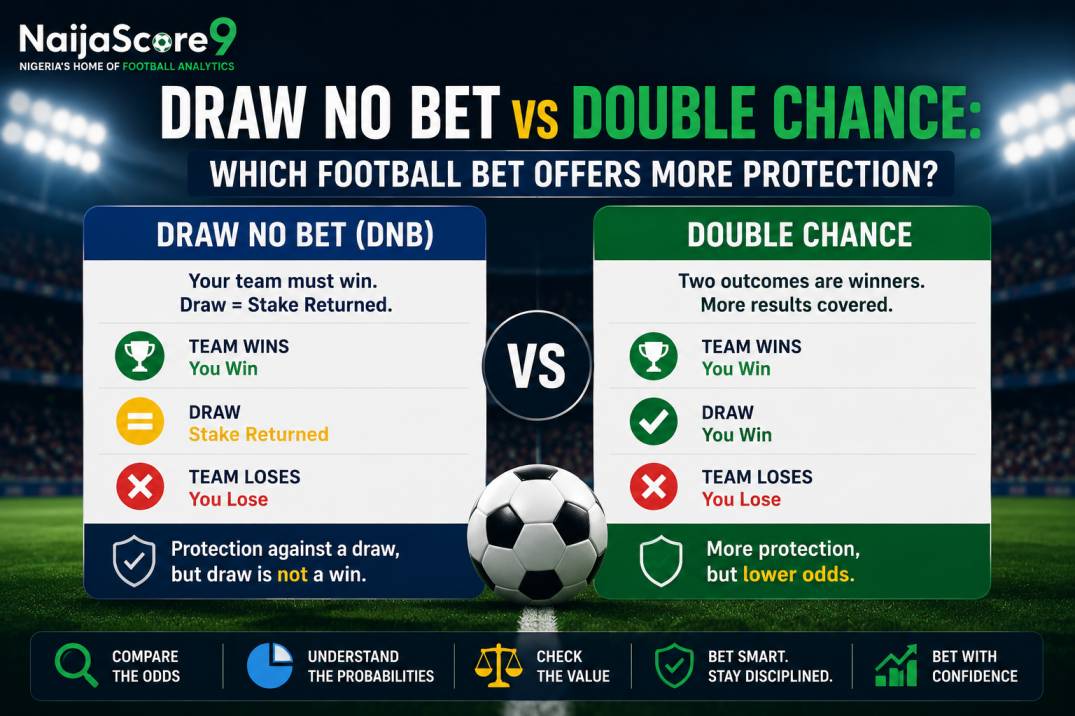
With Draw No Bet, your selected team must win for the bet to produce a profit. If the match ends at level, the stake is returned.
With Double Chance, two of the three possible match results are included in one selection. A home-or-draw selection wins whether the home team wins or the match is drawn.
This produces the central distinction:
Draw No Bet protects your stake against a draw. Double Chance can turn the draw into a winning result.
Double Chance therefore provides broader outcome protection when you select 1X or X2, but that additional protection is normally reflected in lower odds.
The correct choice depends on whether your analysis suggests that the team is likely to win or simply likely to avoid defeat.
Draw No Bet vs Double Chance: Quick Comparison
| Feature | Draw No Bet | Double Chance |
| Outcomes covered | One team to win, with draw refunded | Two of the three 1X2 results |
| Selected team wins | Bet wins | Bet wins for 1X or X2 |
| Match is drawn | Stake returned | Bet wins for 1X or X2 |
| Selected team loses | Bet loses | Bet loses for 1X or X2 |
| Typical odds | Higher | Lower |
| Main purpose | Protect stake against a draw | Cover two results as winners |
| Best suited to | A team expected to win but with draw risk | A team expected not to lose |
| Equivalent market | Asian Handicap 0 | 1X, X2 or 12 |
Smarkets defines Draw No Bet as a two-way football market in which a home or away team is selected, with the stake returned if the match ends level. Its football rules state that the market is settled on the full-time result and voided when the result is a draw.
Bet365 defines Double Chance as a market covering two of the three match-result possibilities: home or draw, draw or away, or home or away.
What Is Draw No Bet?
Draw No Bet removes the draw as a losing outcome when backing either team.
The available selections are normally:
- home team Draw No Bet;
- away team Draw No Bet.
The market is settled as follows:
| Final result | Home Draw No Bet | Away Draw No Bet |
| Home win | Wins | Loses |
| Draw | Stake returned | Stake returned |
| Away win | Loses | Wins |
Suppose Lagos United face Abuja City and you select:
Lagos United – Draw No Bet
The possible outcomes are:
- Lagos United win: the bet wins;
- match ends level: the stake is returned;
- Abuja City win: the bet loses.
Draw No Bet is therefore not a bet on the team to avoid defeat.
A draw does not produce a profit. It produces a refund.
This distinction matters because some users describe Draw No Bet as though both a win and a draw are winning outcomes. That description is incorrect.
Is Draw No Bet the Same as Asian Handicap 0?
In standard settlement terms, Draw No Bet is generally equivalent to Asian Handicap 0.
When a team is selected at a zero handicap:
- a win produces a winning bet;
- a draw produces a refund;
- a defeat produces a losing bet.
Smarkets describes a level Asian Handicap as effectively the same as Draw No Bet because the draw is removed and the stake is returned when the match finishes level.
The displayed prices may still differ slightly between bookmakers or market sections. Before comparing them, confirm that:
- both markets apply to the same match period;
- both use the same settlement conditions;
- extra time is treated consistently;
- the accepted odds are still available.
What Is Double Chance?
Double Chance combines two possible outcomes from the standard three-way football market.
The three conventional selections are:
1X: Home Win or Draw
The bet wins if:
- the home team wins;
- The match ended in a draw.
It loses only if the away team wins.
X2: Draw or Away Win
The bet wins if:
- the match ends in a draw;
- The away team wins.
It loses only if the home team wins.
12: Home Win or Away Win
The bet wins if:
- the home team wins;
- the away team wins.
It loses if the match ends in a draw.
Bet365’s football rules confirm these three structures: 1X covers a home win or draw, X2 covers a draw or away win, and 12 covers either team winning.
Important: Not Every Double Chance Bet Provides Team Protection
When comparing Draw No Bet with Double Chance, most users mean:
- home Draw No Bet vs 1X;
- away Draw No Bet vs X2.
The third Double Chance option, 12, is different.
It does not protect a particular team. It covers both teams to win and lose if the match is drawn.
For example:
| Final result | Double Chance 12 |
| Home win | Wins |
| Draw | Loses |
| Away win | Wins |
This market may be considered when the analysis suggests that the match is unlikely to finish level.
It should not be described as a safer alternative to backing one particular team.
Which Provides More Protection?
For backing one team, Double Chance 1X or X2 provides more result protection than Draw No Bet.
Consider a home-team selection:
| Result | Home Draw No Bet | Double Chance 1X |
| Home win | Wins | Wins |
| Draw | Refunded | Wins |
| Away win | Loses | Loses |
The difference is the draw.
With Draw No Bet, the draw returns the stake.
With Double Chance 1X, the draw produces a winning settlement.
Therefore:
- Double Chance provides greater outcome coverage.
- Draw No Bet usually offers a higher price.
The additional protection is not free. It is reflected in the odds.
Protection Does Not Mean Better Value
A market can provide greater protection without offering better value.
Suppose the available prices are:
- Lagos United Draw No Bet: 1.60;
- Lagos United or Draw: 1.35.
The Double Chance selection covers more winning outcomes, but its payout is smaller.
To determine which is better priced, you need estimated probabilities for:
- Lagos United winning;
- the match finishing level;
- Abuja City winning.
You cannot judge value from protection alone.
Worked Example: Draw No Bet vs Double Chance
Consider the following independent probability estimate:
| Outcome | Estimated probability |
| Lagos United win | 45% |
| Draw | 30% |
| Abuja City win | 25% |
| Total | 100% |
These figures are illustrative rather than a prediction for a real fixture.
Standard Home-Win Probability
The estimated probability of Lagos United winning is:
45%
Estimated fair odds:
1 ÷ 0.45 = 2.22
Lagos United or Draw Probability
The 1X Double Chance selection wins if Lagos United win or the match is drawn.
45% + 30% = 75%
Estimated fair odds:
1 ÷ 0.75 = 1.33
Lagos United Draw No Bet Probability Structure
Draw No Bet cannot be assessed simply by adding the home and draw probabilities because a draw produces neither a win nor a loss.
The relevant outcomes are:
- win probability: 45%;
- refund probability: 30%;
- loss probability: 25%.
The fair Draw No Bet odds can be calculated by removing the draw and comparing the two decisive results:
Fair DNB odds = (home-win probability + away-win probability) ÷ home-win probability
Using the example:
(0.45 + 0.25) ÷ 0.45 = 1.56
The estimated fair prices are therefore:
| Selection | Estimated fair odds |
| Lagos United to win | 2.22 |
| Lagos United Draw No Bet | 1.56 |
| Lagos United or Draw | 1.33 |
The increased protection steadily reduces the fair price:
- standard win offers the least protection and highest odds;
- Draw No Bet refunds the draw and offers lower odds;
- Double Chance wins on the draw and offers the lowest odds.
Naira Payout Comparison
Suppose a bookmaker offers:
- Lagos United to win: 2.15;
- Lagos United Draw No Bet: 1.52;
- Lagos United or Draw: 1.29.
Assume a ₦10,000 stake.
If Lagos United Win
| Market | Total return | Profit |
| Standard win at 2.15 | ₦21,500 | ₦11,500 |
| Draw No Bet at 1.52 | ₦15,200 | ₦5,200 |
| Double Chance 1X at 1.29 | ₦12,900 | ₦2,900 |
If the Match Is Drawn
| Market | Settlement |
| Standard win | Loses ₦10,000 |
| Draw No Bet | ₦10,000 stake returned |
| Double Chance 1X | Returns ₦12,900, including ₦2,900 profit |
If Abuja City Win
All three selections lose.
This demonstrates the trade-off:
The more results a market protects, the less it usually pays when the preferred team wins.
When Draw No Bet May Be More Appropriate?
Draw No Bet may fit the analysis when you believe the selected team is more likely to win than lose but consider a draw a meaningful risk.
You Expect the Team to Win
Your main forecast should still be a victory.
Draw No Bet is not designed primarily for situations where you expect a draw. Its profitability depends on the selected team winning.
A suitable analytical view might be:
- selected team has the stronger probability;
- opponent is capable of forcing a draw;
- outright win odds appear risky;
- Double Chance odds are too short.
The Draw Probability Is Significant but Not Dominant
Suppose your probability estimate is:
- selected team win: 48%;
- draw: 28%;
- selected team lose: 24%.
The selected team is twice as likely to win as lose in this estimate.
Draw No Bet can isolate that relative advantage while neutralising the draw.
You Want Better Odds Than Double Chance
Draw No Bet normally offers a higher price than 1X or X2 because the draw is refunded rather than settled as a winner.
That higher price may be important when the Double Chance price is too low relative to your probability estimate.
You Are Backing a Competitive Away Team
Away teams often receive longer match-result prices because of home advantage.
If your analysis suggests that the away team can win but the draw remains a substantial possibility, away Draw No Bet may offer a middle position between:
- an outright away win;
- X2 Double Chance.
You Want to Separate Winning and Non-Losing Forecasts
Draw No Bet is most suitable when the analysis says:
“This team is more likely to win than lose.”
Double Chance is more suitable when the analysis says:
“This team is unlikely to lose.”
Those statements sound similar, but they represent different probability structures.
When Double Chance May Be More Appropriate?
Double Chance may be more suitable when avoiding defeat is central to the forecast.
You Expect a Tight Match
When two teams appear closely matched, a draw can represent a large part of the probability distribution.
For example:
- home win: 36%;
- draw: 34%;
- away win: 30%.
If backing the home team, the 1X probability would be:
36% + 34% = 70%
The home team is not strongly expected to win, but it may have a high probability of avoiding defeat.
Your Analysis Supports “Team Not to Lose”
This can apply when a team has:
- a strong defensive structure;
- a low defeat rate;
- an opponent with limited attacking output;
- an ability to protect level scores;
- sufficient quality to compete without dominating.
The relevant conclusion is not necessarily that the team will win.
It is that the opposing team has a relatively low win probability.
You Prefer the Draw to Produce Profit
With Draw No Bet, a draw only returns the stake.
With 1X or X2, a draw is included as a winning outcome.
Double Chance is therefore more suitable when the draw is not merely a risk to neutralise but an important part of your positive forecast.
You Are Building a Conservative Multi-Selection Bet
Some users combine Double Chance selections in an accumulator because each leg covers two outcomes.
However, the combined probability still decreases as more selections are added. Multiple low-priced selections do not become safe merely because each one includes Double Chance protection.
Every leg must still be assessed for value, market margin and correlation.
Draw No Bet vs Double Chance for Favourites
Suppose a home favourite has these estimated probabilities:
- home win: 62%;
- draw: 23%;
- away win: 15%.
Home Draw No Bet
The fair DNB odds are:
(0.62 + 0.15) ÷ 0.62 = 1.24
Double Chance 1X
The probability of home win or draw is:
62% + 23% = 85%
Fair odds:
1 ÷ 0.85 = 1.18
Both prices are likely to be short.
For a strong favourite, Double Chance may add relatively little practical protection because the ordinary home-win probability is already high. The reduction in price can be substantial compared with the additional probability covered.
The correct comparison should include:
- straight home-win odds;
- Draw No Bet odds;
- 1X Double Chance odds;
- your fair price for each market.
Do not automatically choose the market with the highest success probability.
Draw No Bet vs Double Chance for Underdogs
The difference can become more meaningful when backing an underdog.
Suppose the estimated probabilities are:
- home favourite: 52%;
- draw: 28%;
- away underdog: 20%.
Away Draw No Bet
The away team wins 20%, draws 28% and loses 52%.
Fair DNB odds:
(0.20 + 0.52) ÷ 0.20 = 3.60
Away or Draw Double Chance
The X2 probability is:
20% + 28% = 48%
Fair odds:
1 ÷ 0.48 = 2.08
Away Draw No Bet offers a much higher potential payout, but the team must win to generate profit.
X2 offers stronger protection because both an away win and a draw produce winning returns.
The analytical choice is:
- Away DNB: Is the underdog’s winning probability underestimated?
- X2: Is the favourite’s winning probability overestimated?
These are not identical questions.
Draw No Bet vs Double Chance for an Away Team
Away-team markets require careful consideration of home advantage.
An away team may be technically stronger but face:
- travel;
- a difficult pitch;
- strong home support;
- reduced rest;
- a tactical opponent;
- uncertain rotation.
Draw No Bet can be useful when the away team appears more likely to win than lose, while X2 may be more appropriate when the main forecast is that it will avoid defeat.
Before deciding, estimate all three outcomes rather than relying only on recent away results.
Draw No Bet vs Double Chance in Knockout Matches
Standard football markets are commonly settled on normal time plus stoppage time, excluding extra time and penalties unless the market specifically states otherwise. Betfair’s 90-minute rule explains that a team progressing after extra time can still lose a normal-time win selection when the score was level after 90 minutes.
This matters in:
- cup matches;
- second-leg ties;
- tournament knockout fixtures;
- qualification play-offs.
Suppose a match finishes:
- 1–1 after 90 minutes;
- 2–1 after extra time.
For ordinary 90-minute markets:
- home Draw No Bet: stake returned;
- home or draw Double Chance 1X: wins;
- home team to win: loses;
- home team to qualify: may win.
Always confirm whether the market refers to:
- 90-minute result;
- extra-time result;
- team to qualify;
- team to lift the trophy.
Which Market Has the Higher Odds?
Draw No Bet generally offers higher odds than the corresponding 1X or X2 Double Chance selection.
The reason is straightforward:
- DNB requires the selected team to win for a profit;
- Double Chance also pays as a winner when the match is drawn.
For a home team:
| Market | Winning outcomes | Refund outcomes |
| Home DNB | Home win | Draw |
| 1X | Home win or draw | None under normal settlement |
Covering the draw as a winner increases the selection’s probability, which normally reduces its price.
Higher odds do not automatically make Draw No Bet the better option. They only reflect its narrower winning conditions.
Which Market Has the Lower Risk?
If risk is defined as the probability of losing the full stake:
- home DNB loses only on an away win;
- 1X also loses only on an away win.
Under standard settlement, both have the same match result that causes a complete loss.
However, their treatment of the draw differs:
- DNB refunds;
- 1X wins.
Therefore, Double Chance offers the stronger financial outcome on a draw.
A more accurate description is:
- both protect against losing the stake on a draw;
- Double Chance provides greater upside on the draw;
- Draw No Bet provides greater payout potential on a team win.
Which Market Is Safer?
Double Chance 1X or X2 is usually considered safer in terms of outcome coverage because two match results produce a winning bet.
But “safer” should not be confused with:
- guaranteed;
- better value;
- more profitable;
- suitable for every match.
A price of 1.20 can still be poor value if the covered outcomes have a realistic combined probability below 83.33%.
The NaijaScore9 implied probability calculator can convert the displayed price into its raw break-even probability.
Bookmaker Margin in DNB and Double Chance Markets
Both markets usually include a bookmaker margin.
For a two-way Draw No Bet market, suppose the prices are:
| Outcome | Odds | Raw implied probability |
| Home DNB | 1.60 | 62.50% |
| Away DNB | 2.35 | 42.55% |
| Total | — | 105.05% |
The raw probabilities total 105.05%.
Estimated overround:
105.05% − 100% = 5.05%
Smarkets explains that a two-way market margin can be calculated by adding the implied probabilities of both offered outcomes and measuring the amount above 100%.
For Double Chance, compare all three options when the complete market is available:
- 1X;
- X2;
Do not treat one displayed price as a margin-free probability.
The NaijaScore9 No-Vig Calculator can help analyse complete two-way or three-way prices, although the resulting probabilities remain market-derived estimates rather than objective truth.
Comparing Draw No Bet Across Bookmakers
Suppose three operators offer:
| Bookmaker | Lagos United DNB |
| Bookmaker A | 1.52 |
| Bookmaker B | 1.58 |
| Bookmaker C | 1.55 |
For a ₦20,000 stake:
| Bookmaker | Potential return | Potential profit |
| A | ₦30,400 | ₦10,400 |
| B | ₦31,600 | ₦11,600 |
| C | ₦31,000 | ₦11,000 |
Bookmaker B offers the strongest price, assuming:
- the event is identical;
- normal-time settlement matches;
- void rules are equivalent;
- the odds are compared at the same time;
- the full intended stake is accepted.
Small price differences can materially affect returns across repeated decisions.
Comparing Double Chance Across Bookmakers
Suppose the 1X prices are:
| Bookmaker | Home or Draw |
| Bookmaker A | 1.29 |
| Bookmaker B | 1.34 |
| Bookmaker C | 1.31 |
For a ₦20,000 stake:
| Bookmaker | Potential return | Potential profit |
| A | ₦25,800 | ₦5,800 |
| B | ₦26,800 | ₦6,800 |
| C | ₦26,200 | ₦6,200 |
The same principle applies: use the highest accepted price for the exact same market and settlement conditions.
NaijaScore9’s guide on how to compare the same betting market across different bookmakers explains why the line, match period, rules and comparison time must match before ranking the prices.
Draw No Bet vs Double Chance Expected Value
Expected value compares the probability of each financial outcome with the return attached to it.
DNB Expected Value
Suppose:
- win probability: 45%;
- draw probability: 30%;
- loss probability: 25%;
- DNB odds: 1.60.
For a ₦1 unit stake:
- profit if team wins: ₦0.60;
- profit or loss on draw: ₦0;
- loss if team loses: −₦1.
Expected value:
(0.45 × 0.60) + (0.30 × 0) − (0.25 × 1)
0.27 − 0.25 = +0.02
Estimated expected value:
+2%
Double Chance Expected Value
Suppose:
- probability of home win or draw: 75%;
- probability of away win: 25%;
- 1X odds: 1.30.
Profit per winning unit:
1.30 − 1 = 0.30
Expected value:
(0.75 × 0.30) − (0.25 × 1)
0.225 − 0.25 = −0.025
Estimated expected value:
−2.5%
In this example, Double Chance offers more protection but worse estimated value.
This does not establish a universal result. Different odds or probabilities can reverse the comparison.
Probability Range Analysis
Football probabilities are uncertain.
Instead of relying on one exact estimate, consider a realistic range.
Suppose your estimates for the home team are:
| Scenario | Home win | Draw | Away win |
| Conservative | 41% | 31% | 28% |
| Central | 45% | 30% | 25% |
| Optimistic | 49% | 29% | 22% |
At DNB odds of 1.60:
- the price may be unattractive in the conservative scenario;
- approximately favourable in the central scenario;
- more favourable in the optimistic scenario.
At 1X odds of 1.30:
- the combined probability ranges from 72% to 78%;
- the break-even probability is 76.92%.
The Double Chance price may appear favourable only near the optimistic end of the range.
This shows why market selection should follow probability analysis rather than the desire for protection alone.
How Team Style Affects the Comparison
Low-Scoring Teams
Teams involved in low-scoring matches may produce a relatively high draw probability.
That can make:
- DNB protection more relevant;
- 1X or X2 probabilities larger;
- standard match-result prices riskier.
However, bookmakers also account for draw tendencies in their prices.
Strong Defensive Teams
A team that concedes few high-quality chances may have a good probability of avoiding defeat.
That can support a Double Chance assessment, particularly when its own attacking output is not strong enough to justify a confident win forecast.
High-Variance Attacking Teams
A team that plays aggressively may produce more decisive results and fewer draws.
Draw No Bet protection may be less valuable when the draw probability is low. In some cases, the standard win or Double Chance 12 market may better reflect the analysis.
Teams Protecting a First-Leg Lead
A team entering a second leg with an aggregate advantage may be satisfied with a draw or narrow defeat, depending on the tie.
Competition incentives can change its tactical approach and normal-time probabilities.
Common Draw No Bet Mistakes
Treating a Draw as a Winning Result
A draw returns the stake; it does not produce profit.
Ignoring the Reduced Odds
The draw refund is priced into the market. DNB odds are lower than the ordinary match-win price.
Using DNB When the Main Forecast Is a Draw
If you strongly expect a draw, DNB only produces a refund. A different market may reflect the forecast more directly.
Assuming DNB Is Risk-Free
The full stake is lost when the selected team is defeated.
Ignoring 90-Minute Settlement
A team winning after extra time does not normally turn a drawn 90-minute DNB selection into a winner.
Common Double Chance Mistakes
Assuming Every Double Chance Selection Protects a Team
The 12 option covers either team winning and loses on a draw.
Accepting Extremely Short Prices Without Analysis
A selection can cover two outcomes and still offer poor value.
Adding Too Many Double Chance Legs
Combining several short prices can create a large accumulator with a low overall probability.
Confusing Double Chance With Draw No Bet
A draw wins on 1X or X2 but only refunds a DNB selection.
Ignoring Which Team Is Listed First
In 1X2 notation:
- 1 means the listed home team;
- X means draw;
- 2 means the listed away team.
At a neutral venue, the first-listed team may still be treated as the home selection for betting notation. Bet365’s rules state that the first-listed team is treated as the home team for Double Chance purposes at a neutral venue.
A Simple Decision Framework
Choose Draw No Bet When:
Your analysis is approximately:
“The selected team is more likely to win than lose, but the draw risk is too significant for the ordinary match-result price.”
Choose Double Chance 1X or X2 When:
Your analysis is approximately:
“The selected team may not win, but the opponent is unlikely to beat it.”
Choose Neither When:
- both prices are below your estimated fair odds;
- line-up uncertainty is too high;
- the market margin is excessive;
- the odds have moved beyond an acceptable price;
- your probability estimate is not sufficiently reliable.
Choosing not to place a selection is a valid analytical outcome.
Final Assessment
Draw No Bet and Double Chance both reduce exposure compared with a standard match-result selection, but they are designed for different probability views.
Draw No Bet:
- requires the selected team to win for profit;
- refunds the draw;
- loses if the opponent wins;
- normally offers higher odds.
Double Chance 1X or X2:
- wins if the selected team wins;
- also wins if the match is drawn;
- loses only if the opponent wins;
- normally offers lower odds.
Therefore, Double Chance provides more outcome protection, while Draw No Bet preserves more payout potential.
The better choice is determined by the forecast:
- choose DNB when the team is expected to win but the draw needs to be neutralised;
- choose 1X or X2 when the main expectation is that the team will avoid defeat;
- choose neither when the available prices are below your estimated fair odds.