
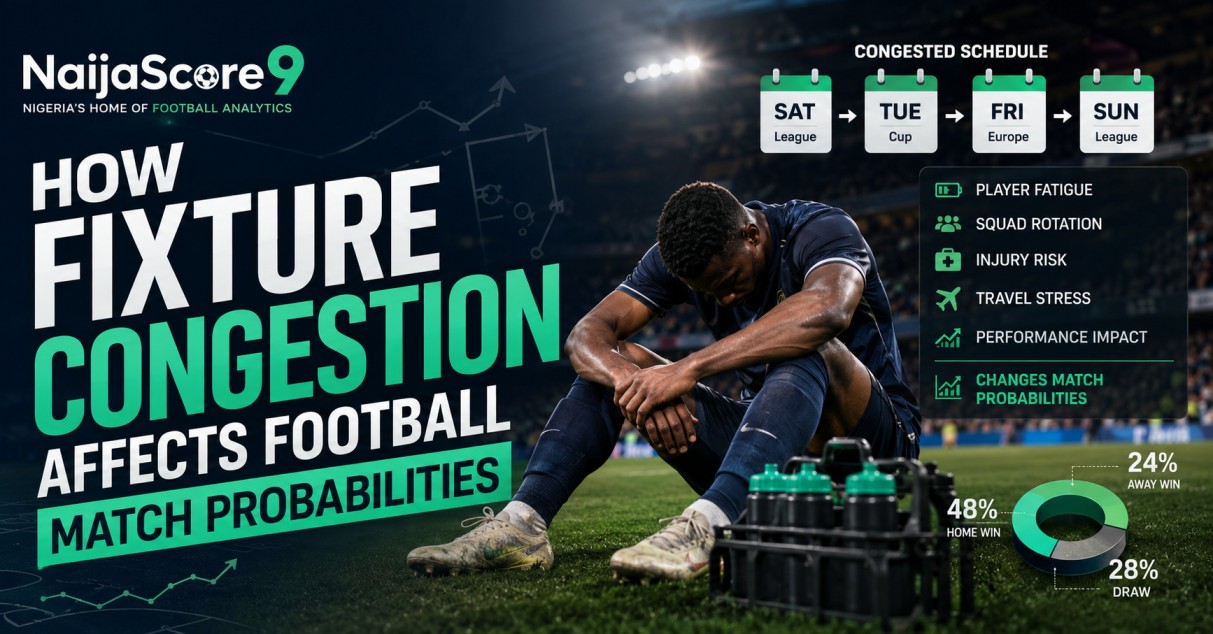
A team playing three matches in eight days may appear to be an obvious candidate for a poor result. Its players have had less time to recover, the manager may rotate the starting line-up, and another important competition could be influencing team selection.
However, fixture congestion does not automatically mean that the affected team will lose.
Strong squads can rotate players, reduce training loads and adjust their tactical approach. Some teams maintain their technical and running performance surprisingly well during congested periods. Others become more vulnerable because the same core players must repeatedly start, travel and complete demanding matches.
The correct question is therefore not:
“Has this team played recently?”
It is:
“How has the schedule changed this team’s expected performance, player availability and line-up uncertainty for this particular match?”
That distinction is essential when estimating football match probabilities.
What Is Fixture Congestion in Football?
Fixture congestion occurs when a team plays several competitive matches within a relatively short period, leaving limited recovery time between them.
There is no single definition used in every study or competition. In professional football research, congested schedules commonly involve two or three matches within one weekly cycle, sometimes with four days or fewer between games. A club competing domestically and internationally can experience these periods repeatedly across a season. Examples include:
- a domestic league match on Saturday;
- a cup or continental match on Tuesday or Wednesday;
- another league fixture the following weekend;
- two-legged knockout ties;
- international tournaments with short intervals between games;
- postponed matches rearranged into an already busy schedule.
Fixture congestion should be evaluated at both team level and player level.
A club may have three matches in seven days, but a particular player might start only one. Another player could complete all three matches, including extra time in one of them. Their individual fatigue and recovery profiles will not be the same.
Does Fixture Congestion Make Teams Perform Worse?
Not always.
A systematic review and meta-analysis of professional football performance found that fixture congestion did not significantly reduce total distance covered. Technical performance was also generally maintained across congested match periods, although the available tactical evidence was more limited. This is because football fatigue is often oversimplified.
A congested team may still:
- complete a similar number of passes;
- maintain its overall running distance;
- produce a competitive possession share;
- defend effectively;
- win against a weaker opponent.
Teams can preserve performance by rotating players, changing tactics, reducing training volume and managing the intensity of individual matches.
However, stable total-distance figures do not prove that fixture congestion has no effect. Some research has identified reductions in maximal acceleration, deceleration and time spent performing the most demanding movements during congested periods. These explosive actions can be important when pressing, recovering defensively or creating separation from an opponent. Congestion should therefore be treated as a contextual modifier, not an automatic prediction.
Why Fixture Congestion Can Change Match Probabilities?
1. Players May Not Be Fully Recovered
A football match creates physical, physiological and psychological stress. Players require time to restore muscle function, replenish energy stores and recover from collisions, sprints, accelerations and decelerations.
Research comparing shorter recovery intervals found greater markers of inflammation and muscle damage following matches with approximately 48 hours of rest than after matches with around 72 hours of recovery. Match performance did not necessarily collapse, but the underlying recovery state was different. Distinction is important for probability analysis.
A player can still start and complete a match while being less capable of repeatedly producing maximum-intensity actions. The effect may appear through:
- slower defensive recovery;
- reduced pressing intensity;
- fewer overlapping runs;
- less explosive movement;
- declining performance late in the match;
- a greater need for substitution.
Recovery is also individual. Age, position, previous minutes, injury history, travel and the intensity of the previous match can all affect readiness.
A model should not apply the same fatigue penalty to every player.
2. Injury Risk and Player Availability Can Change
The clearest effect of fixture congestion may not be a direct reduction in team performance. It may be the increased probability that an important player is unavailable, restricted, or unable to complete the next match.
A systematic review of professional men’s football found that most included studies reported increased match-injury incidence during congested periods, although the evidence was not identical across every study. search has associated fixture congestion with higher muscle-injury rates while finding only limited changes in overall team performance. Suggests an indirect probability effect:
- Congestion increases physical exposure.
- Increased exposure can affect injury risk and recovery.
- Injuries or fitness doubts change the expected starting line-up.
- A weaker or less balanced line-up changes the team’s match probability.
The availability of one influential centre-back, goalkeeper, midfielder or striker can matter more than the number of rest days by itself.
3. Managers Are More Likely to Rotate
Rotation is one of the main reasons congested teams do not always show an obvious performance decline.
A manager may rest several first-choice players in one match, particularly when:
- a more important fixture follows;
- the opponent is considered weaker;
- the club has a deep squad;
- players have accumulated heavy minutes;
- a knockout tie remains undecided;
- the team has a comfortable league position;
- certain players are returning from injury.
Rotation can protect the team from fatigue, but it introduces line-up uncertainty.
The effect depends on replacement quality. Manchester-level squad depth and the depth available to a smaller club should not be treated equally. A heavily rotated elite team may remain stronger than its opponent. A smaller team replacing three key starters may experience a substantial drop in attacking or defensive quality.
Research showing that some teams maintain performance during congested schedules has specifically noted that squad rotation and recovery strategies may help explain the absence of a major decline. casting purposes, the important variable is not simply the number of changes. It is the difference between the expected starters and their replacements.
4. Tactical Priorities Can Change
A congested team may deliberately play differently.
Instead of pressing aggressively for 90 minutes, it may:
- defend in a more compact shape;
- slow the tempo in possession;
- avoid unnecessary transitions;
- take fewer risks when leading;
- make substitutions earlier;
- protect specific players;
- accept a draw in an away fixture.
These decisions can preserve physical resources while changing the probability distribution of the match.
For example, a strong away team facing another match three days later might remain more likely to win than its opponent. However, a more cautious tactical plan could move some probability from the away win towards the draw.
This does not mean every congested match will be low-scoring. Rotation can weaken defensive organisation, while tired teams may leave more space during transitions. The direction of the adjustment depends on the expected line-ups and tactics.
5. Late-Match Vulnerability May Increase
Fatigue does not always affect every minute equally.
One professional football study found a higher injury risk in the final 15 minutes of the second match within short congestion cycles compared with matches outside those cycles. iction analysis, the final stages deserve particular attention when a team has:
- repeatedly used the same starters;
- played extra time recently;
- travelled between fixtures;
- limited substitute quality;
- defended for long periods;
- already shown late declines in previous matches.
A congested favourite may control the opening stages but become less reliable at maintaining intensity or protecting a narrow lead.
This can affect markets connected to:
- second-half goals;
- late equalising goals;
- draw probability;
- team clean sheets;
- in-play performance;
- the timing of substitutions.
These should still be treated as conditional possibilities, not universal rules.
6. Extra Time Adds More Than Another 30 Minutes
A recent cup match that lasted 120 minutes should not be treated like an ordinary 90-minute match.
Extra time adds additional running, accelerations, collisions and psychological pressure. Penalty shootouts can also delay post-match recovery because players remain physically and mentally engaged for longer.
Research has found that extra-time participation can negatively affect recovery indicators in the following 36 hours, with some players still showing performance-related effects when another match is played shortly afterwards. lysing a team’s schedule, record:
- whether the previous match required extra time;
- which players completed 120 minutes;
- whether penalties were played;
- the intensity of the match;
- the time between the final whistle and the next kick-off.
Looking only at the calendar date can understate the real workload.
7. Travel Can Reduce the Value of Rest Days
Two teams may each have four days between fixtures but experience very different recovery conditions.
One may play both matches at home. The other may return from a distant continental away match, pass through multiple airports and then prepare for another fixture.
Travel can reduce available recovery time through:
- late-night arrivals;
- disrupted sleep;
- time-zone changes;
- long road journeys;
- limited training preparation;
- unfamiliar climate or playing conditions.
This is particularly relevant in continental competitions and international football. Nigerian audiences analysing UEFA, CAF or international fixtures should consider the journey—not only the official number of rest days.
A four-day interval with extensive travel may provide less effective recovery than a three-day interval between two local home matches.
Fixture Congestion Does Not Affect Every Team Equally
The same schedule can produce different outcomes for different clubs.
Deep Squads
Teams with high-quality replacements can rest important players without dramatically reducing expected strength.
They may also have:
- advanced recovery facilities;
- larger medical and performance teams;
- more tactical flexibility;
- substitutes capable of changing matches;
- players accustomed to European or continental schedules.
Thin Squads
Teams with limited depth may repeatedly depend on the same core players. Their replacements can represent a significant drop in quality.
Congestion becomes more important when:
- several positions lack reliable alternatives;
- the team already has injuries;
- key players are older;
- substitutes have little competitive experience;
- the tactical system depends on specific individuals.
Young Squads
Younger players may recover well physically, but inexperienced replacements can make tactical mistakes when rotated into important matches.
Older Squads
Experienced teams may manage matches intelligently, but repeated high-minute exposure can increase concerns about recovery and muscle injuries.
Age should never be considered in isolation. The player’s position, minutes, previous injuries, and role are also important.
How to Include Fixture Congestion in Football Probability Analysis?
Fixture congestion should be incorporated through a sequence of adjustments rather than one arbitrary fatigue percentage.
Step 1: Establish the Baseline Probability
First estimate the match without a congestion adjustment.
Consider:
- underlying team strength;
- home advantage;
- recent performances;
- opponent quality;
- expected goals data;
- attacking and defensive ratings;
- injuries and suspensions already known;
- market prices.
Suppose the initial assessment is:
| Outcome | Baseline probability |
| Home win | 55% |
| Draw | 25% |
| Away win | 20% |
These values are only an illustrative example.
Step 2: Compare Effective Recovery
Do not record only “three days of rest” or “five days of rest.”
Compare:
- hours between the two kick-offs;
- time of the previous final whistle;
- extra time;
- travel;
- home or away status;
- training opportunities;
- previous-match intensity.
The difference between the teams is often more useful than the absolute number.
Step 3: Measure Player-Level Minutes
Record the recent workload of likely starters.
A simple table can include:
| Player | Minutes in last 7 days | Extra time | Travel | Expected role |
| Starting centre-back | 210 | Yes | Long trip | Likely starter |
| Central midfielder | 180 | No | Long trip | Rotation risk |
| Main striker | 95 | No | Long trip | Likely starter |
| Reserve winger | 25 | No | Long trip | Possible starter |
This reveals more than the team’s fixture count.
Step 4: Estimate the Starting Line-Up
Identify:
- confirmed absences;
- fitness doubts;
- players likely to be rested;
- likely replacements;
- possible formation changes;
- the manager’s historical rotation patterns.
Line-up uncertainty should widen the probability range rather than produce false precision.
For example, the home-win estimate might be:
- 54% with the strongest available line-up;
- 49% with moderate rotation;
- 44% with several key players rested.
Before team news, the analyst should account for all credible scenarios.
Step 5: Evaluate Competition Priority
Not every match has equal strategic value.
A manager may prioritise:
- a continental knockout match;
- a relegation battle;
- a title-deciding league fixture;
- a domestic cup final;
- qualification for the next round;
- a rivalry match.
Competition priority influences who starts, how aggressively the team plays and how substitutions are used.
Avoid assuming that the league match is always more important than the cup match—or the reverse.
Step 6: Adjust the Probability, Not the Narrative
Suppose the baseline home-win probability is 55%.
After reviewing short recovery, extensive travel, a likely rotated midfield and a demanding 120-minute cup match, the revised estimate might become:
| Outcome | Baseline | Congestion-adjusted |
| Home win | 55% | 48% |
| Draw | 25% | 28% |
| Away win | 20% | 24% |
This is an illustration, not a universal formula.
A deep squad with minimal rotation uncertainty might require only a small adjustment:
| Outcome | Baseline | Congestion-adjusted |
| Home win | 55% | 52% |
| Draw | 25% | 26% |
| Away win | 20% | 22% |
The evidence does not support applying the same fixed penalty to every team playing on short rest. Performance outcomes vary because rotation, recovery strategies, squad depth and individual exposure vary. Fixture Congestion Can Affect Different Betting Markets
Match Result
A congested favourite may deserve a lower win probability when important starters are likely to be rested or physically restricted.
However, short rest alone is insufficient reason to oppose a strong team.
Draw Probability
The draw probability may increase when a congested team adopts a cautious strategy, reduces pressing intensity or prioritises game control over attacking risk.
It can also decrease if defensive rotation creates instability. Expected tactics matter.
Over and Under Goals
Fixture congestion can influence totals in opposite directions.
It may reduce scoring when:
- attackers are rested;
- the tempo is deliberately controlled;
- teams conserve energy;
- the favourite accepts a narrow win.
It may increase scoring when:
- rotated defenders lack coordination;
- tired players defend transitions poorly;
- substitutes change the match late;
- both sides have compressed schedules.
Do not use fixture congestion as an automatic Under 2.5 Goals signal.
Both Teams to Score
BTTS probability can rise if both defences are rotated or less capable of sustaining intensity. It can fall if one side rotates its attack and plays conservatively.
Evaluate the expected personnel in both penalty areas.
Player Markets
Player-based markets are particularly sensitive to congestion because the individual may:
- start on the bench;
- play fewer minutes;
- move into a different role;
- avoid set-piece duties;
- be substituted earlier.
Wait for confirmed line-ups when possible.
Live Betting
The effect of congestion may become more visible during the match.
Watch for:
- declining pressing intensity;
- delayed defensive recovery;
- early substitutions;
- reduced overlapping runs;
- repeated stoppages;
- one team becoming territorially dominant.
Live observations should update the pre-match estimate, not merely confirm the original opinion.
Common Fixture-Congestion Analysis Mistakes
Assuming Every Tired Team Will Lose
Football quality does not disappear because a team played three days earlier. Strong teams regularly win during congested periods.
Counting Fixtures Instead of Minutes
A player appearing as a substitute for 12 minutes has not experienced the same workload as a player completing 120 minutes.
Ignoring Squad Depth
Five changes can be manageable for one club and damaging for another.
Ignoring the Opponent’s Schedule
Congestion is comparative. The opponent may have an equally demanding or worse schedule.
Using Recent Results Without Context
A team may have lost its previous match while resting several starters. The score alone does not represent the expected line-up for the next fixture.
Applying a Fixed Percentage Deduction
There is no evidence-based rule that every congested team should lose exactly 5%, 10% or another fixed amount from its win probability.
Ignoring Team News
A congestion adjustment made before the line-up announcement may become outdated when the manager names a stronger or weaker team than expected.
Treating Market Movement as Proof
Odds may move because of team news, customer activity, liquidity or bookmaker risk management. A price change does not prove that the market has measured fatigue correctly.
Fixture Congestion Analysis Checklist
Before adjusting a football prediction, check:
- How many matches has each team played recently?
- How many minutes have the expected starters completed?
- Did either team play extra time?
- How much travel was involved?
- Were the previous matches physically demanding?
- Which players are injured, suspended or doubtful?
- Is rotation expected?
- How strong are the likely replacements?
- Which competition is the manager likely to prioritise?
- Does the team have a history of rotating in similar situations?
- Are both teams congested?
- Has the market already adjusted its odds?
- How uncertain is the expected line-up?
- Does the proposed probability change reflect evidence or merely a fatigue narrative?
The final forecast should be adjusted only after these questions are considered together.
Why Fixture Congestion Is a Probability Factor, Not a Prediction?
Fixture congestion cannot independently tell you whether a team will win, draw or lose.
It modifies the conditions under which the match will be played.
The effect may appear through:
- reduced player availability;
- uncertain line-ups;
- tactical conservation;
- greater late-match vulnerability;
- weaker replacement quality;
- incomplete physical recovery;
- travel-related disruption.
Research also shows why analysts must remain cautious: overall running and technical performance can be maintained during congested periods, particularly when teams manage minutes and recovery effectively. At the same time, injury incidence and certain high-intensity physical actions may be affected. defensible approach is therefore to apply a team-specific, player-specific, and match-specific adjustment.
Final Assessment
Fixture congestion affects football match probabilities through a chain of connected factors, not through tiredness alone.
A reliable analysis should examine:
- effective recovery time;
- individual player minutes;
- extra time and travel;
- injury and availability risk;
- expected rotation;
- replacement quality;
- tactical priorities;
- the opponent’s schedule.
The strongest teams may absorb congested periods with little visible decline. Less balanced squads may become considerably weaker when two or three important players are rested or unavailable.
For that reason, fixture congestion should never be used as a shortcut for predicting an upset. It should be incorporated as a measured adjustment within a broader football prediction methodology.
A probability remains an estimate. Even a carefully analysed team can perform better or worse than expected, and no schedule-based adjustment can guarantee a match result.