
Imagine Arsenal are playing Chelsea. Arsenal lead 1–0 at half-time and eventually win 2–1. You predicted Arsenal to win the match, so your ordinary home-win selection would be correct. But what if you had selected HT/FT X/1 instead?
That bet would lose, even though Arsenal won. The reason is that HT/FT betting requires you to predict two results, not just the final winner.
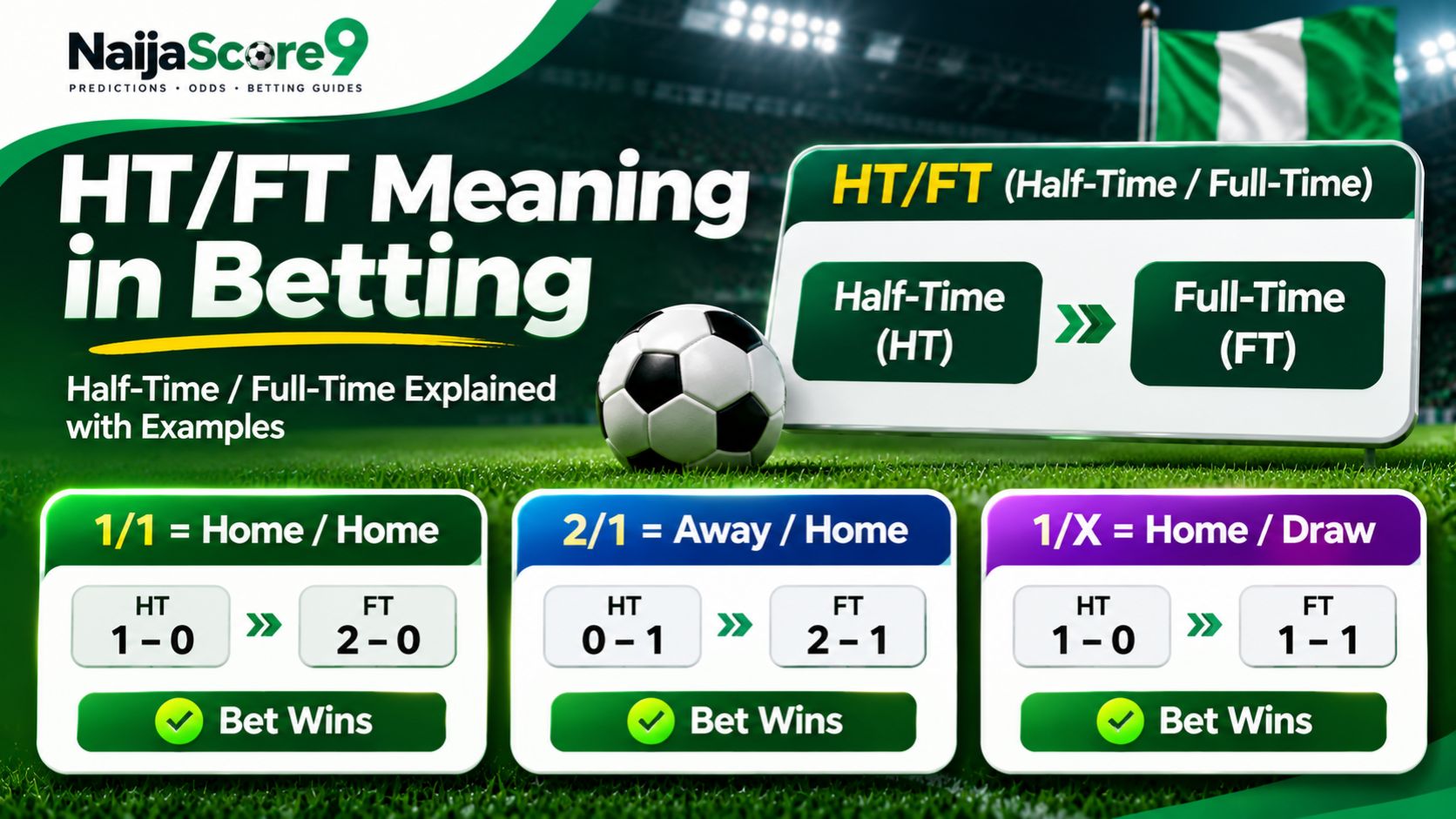
HT/FT means Half-Time/Full-Time. It is a football betting market where you predict the result at half-time and the result at full-time in one selection. Both predictions must be correct for the bet to win.
Bookmakers express these predictions using three familiar symbols: 1 for a home win, X for a draw and 2 for an away win.
For example, HT/FT 1/1 means the home team must be leading at half-time and still win at full-time. HT/FT 2/1 means the away team leads at half-time, but the home team comes back to win. HT/FT 1/X means the home team leads at the break, but the match finishes in a draw.
This guide explains all nine HT/FT results, shows how the market works on Nigerian betting slips and uses practical scoreline and naira examples to make each outcome easy to understand.
What Does HT/FT Mean in Betting?
The meaning of HT/FT in betting is Half-Time/Full-Time, a market that combines two match-result predictions into a single wager.
The first prediction concerns the score when the referee ends the first half. The second concerns the result when the match finishes after normal playing time.
Unlike a regular match-result bet, you are not simply choosing which team will win. You are also predicting what the result will be at the interval.
Consider a hypothetical Premier League match between Liverpool and Everton. Liverpool lead 2–0 at half-time and win 3–1.
The half-time result is a home win, represented by 1. The full-time result is also a home win, represented by 1.
The correct HT/FT outcome is therefore 1/1. Now imagine Liverpool and Everton are level at 0–0 at half-time, but Liverpool eventually win 3–1. The final winner has not changed, but the correct HT/FT selection is now X/1.
That distinction explains why a bettor can predict the correct match winner and still lose an HT/FT wager.
How to Read HT/FT Results on a Betting Slip
HT/FT selections contain two symbols separated by a slash.
The first symbol represents the half-time result. The second represents the full-time result.
| Symbol | Meaning |
| 1 | Home team wins |
| X | Draw |
| 2 | Away team wins |
The same symbols are used on both sides of the slash, but they refer to different moments in the match.
For example, in HT/FT X/2, the X means the teams are level at half-time, while the 2 means the away team wins at full-time. A useful way to remember the order is:
First symbol = Half-time result
Second symbol = Full-time result
The symbols do not represent the number of goals scored. A 1/1 selection does not mean the match must finish 1–1, and 2/1 does not mean you are predicting a 2–1 correct score.
They describe which team is winning, or whether the teams are level, at two separate stages of the match.
All 9 HT/FT Results and Their Meanings
There are three possible results at half-time and three possible results at full-time. Combining them creates nine HT/FT outcomes.
The table below shows what each selection requires, using hypothetical football scores.
| HT/FT | Half-Time Result | Full-Time Result | Example HT → FT |
| 1/1 | Home leads | Home wins | 1–0 → 2–0 |
| 1/X | Home leads | Draw | 1–0 → 1–1 |
| 1/2 | Home leads | Away wins | 1–0 → 1–2 |
| X/1 | Draw | Home wins | 0–0 → 2–0 |
| X/X | Draw | Draw | 0–0 → 1–1 |
| X/2 | Draw | Away wins | 1–1 → 1–2 |
| 2/1 | Away leads | Home wins | 0–1 → 2–1 |
| 2/X | Away leads | Draw | 0–1 → 1–1 |
| 2/2 | Away leads | Away wins | 0–1 → 0–2 |
Every completed match has one corresponding HT/FT outcome under the standard market rules.
The correct selection depends on the result at the interval and the result at the end of normal time. It does not require an exact score prediction.
For example, 1–0 at half-time followed by 2–0 at full-time and 2–1 at half-time followed by 4–2 at full-time qualify as 1/1.
In each case, the home team leads at the break and wins the match.
What Does HT/FT 1/1 Mean in Betting?
HT/FT 1/1 means the home team must be winning at half-time and must also win at full-time.
Both conditions are compulsory. Suppose Enyimba are playing a home match against another NPFL club.
At half-time, Enyimba led 1–0. The match eventually finishes 2–0. An HT/FT 1/1 selection wins because Enyimba were ahead at both required points.
However, imagine the same match finishes 2–0 after a goalless first half. The full-time home win is correct, but the half-time result was a draw. The correct selection would be X/1, not 1/1.
Can HT/FT 1/1 Win if the Home Team Concedes?
Yes. The home team does not need to keep a clean sheet. For example, a half-time score of 2–1 followed by a full-time score of 3–2 qualifies as 1/1. The home side led at half-time and still won the match.
Does 1/1 Mean the Match Must Finish 1–1?
No. This is a common misunderstanding. In HT/FT betting, 1/1 means Home/Home, not a 1–1 draw. If the match finishes 1–1, the full-time result is X. Therefore, 1/1 cannot win.
What Does HT/FT 2/1 Mean?
HT/FT 2/1 means the away team must lead at half-time, but the home team must recover and win the match at full-time.
This is a comeback outcome. Suppose Manchester United are hosting Tottenham in a hypothetical match.
Tottenham scored first and led 1–0 at half-time. Manchester United scored twice after the break and won 2–1. The half-time result was an away win, represented by 2. The full-time result was a home win, represented by 1.
The correct HT/FT outcome is 2/1. But if the match finishes 1–1, a 2/1 selection loses. Although the home team recovered from being behind, they did not win the match.
Why Does HT/FT 2/1 Often Have High Odds?
A 2/1 selection requires a specific sequence of results. The away team must be ahead at half-time, and the home team must then turn the match around sufficiently to win. That is more restrictive than simply predicting a home victory.
The higher quoted odds often reflect the lower probability of this particular match progression. However, the exact price depends on the teams, market conditions and bookmaker margin.
High odds should not be mistaken for good value.
Does HT/FT 2/1 Mean a 2–1 Correct Score?
No. HT/FT 2/1 and correct score 2–1 are different markets.
A match can finish 2–1 without qualifying as HT/FT 2/1. For instance, if the home team lead 1–0 at half-time and wins 2–1, the correct HT/FT result is 1/1.
To win 2/1, the away team must have been ahead at half-time before the home team completed the comeback.
What Does HT/FT 1/X Mean?
HT/FT 1/X means the home team leads at half-time, but the match ends in a draw. Imagine Arsenal are playing Brighton.
Arsenal led 1–0 at the interval. Brighton equalised in the second half, and the match finished 1–1.
The half-time result was 1, and the full-time result was X. That makes 1/X the winning selection.
A 2–2 final score could also qualify, provided the home team was leading at half-time.
The important condition is not the number of goals. It is the transition from a home lead at half-time to a draw at full-time.
Is HT/FT 1/X the Same as Double Chance 1X?
No, and confusing these markets can lead to an incorrect selection. HT/FT 1/X requires a home lead at half-time and a draw at full-time.
Double Chance 1X covers a home win or draw at full-time, regardless of the half-time result. Suppose Arsenal lead 1–0 at half-time and win 2–0.
Double Chance 1X wins because Arsenal won. HT/FT 1/X loses because the match did not finish level. The slash in HT/FT separates two match periods. In Double Chance, 1X represents two alternative final results.
Other HT/FT Outcomes Explained
The remaining combinations follow the same principle, but each represents a different match progression.
HT/FT X/1: Draw at Half-Time, Home Win at Full-Time
X/1 requires the teams to be level at the interval before the home side wins. For example, a match is 0–0 at half-time and finishes 2–0.
The home team did not lead during the first half, so 1/1 would lose. X/1 wins because the first result was a draw and the second was a home victory.
A 1–1 half-time score followed by a 3–1 home win also qualifies.
HT/FT X/2: Draw at Half-Time, Away Win at Full-Time
X/2 is the away-team equivalent of X/1. The teams must be level at half-time, and the away team must win the match.
For example, a match is 1–1 at half-time before the away team scores the winner to make it 1–2. The correct outcome is X/2.
HT/FT X/X: Draw at Half-Time and Full-Time
X/X requires the match to be level at both checkpoints. The score does not need to remain unchanged.
A 0–0 half-time score followed by a 1–1 final result qualifies as X/X. So does a 1–1 half-time score followed by a 2–2 final result.
The market is concerned with whether the match is drawn at each checkpoint, not whether the score remains exactly the same.
HT/FT 2/2: Away Team Leads at Both Checkpoints
2/2 requires the away team to be ahead at half-time and win at full-time. For example, the away team leads 0–1 at the break and eventually wins 1–3.
Both conditions are satisfied. If the teams were level at half-time before the away team won, the correct selection would instead be X/2.
HT/FT 1/2: Home Team Leads, Away Team Comes Back to Win
1/2 is another comeback outcome. The home team must lead at half-time, but the away team must eventually win.
For example, a 1–0 half-time lead turns into a 1–2 away victory. The result is 1/2.
This selection requires more than an away-team comeback to a draw. The visitors must finish ahead.
HT/FT 2/X: Away Team Leads, Match Finishes Drawn
2/X means the away team is ahead at the interval, but the home side recovers enough to draw the match.
A 0–1 half-time score followed by a 1–1 full-time score is a typical example. If the home team scores again and wins 2–1, the correct result becomes 2/1.
Why the Same Full-Time Score Can Produce Different HT/FT Results
One of the easiest ways to understand HT/FT is to keep the final score unchanged and change only the half-time result.
Imagine three hypothetical matches all finishing 2–1 to the home team.
| Match | Half-Time | Full-Time | Correct HT/FT |
| A | 1–0 | 2–1 | 1/1 |
| B | 0–0 | 2–1 | X/1 |
| C | 0–1 | 2–1 | 2/1 |
All three matches finish with the same score. Every ordinary home-win bet succeeds. Yet the HT/FT outcomes are completely different.
This is why analysing only the likely final winner is not enough for the Half-Time/Full-Time market. You must consider how the match might develop before and after the interval.
How HT/FT Odds and Payouts Work?
HT/FT selections generally carry longer odds than ordinary 1X2 results because they require a more specific outcome.
For example, a normal home-win bet covers a home victory regardless of whether the team led, drew or trailed at half-time.
HT/FT 1/1 covers only home victories where the home side was also ahead at the break. That narrower condition helps explain the difference in price.
Example: HT/FT 1/1 at 2.20 Odds
Suppose a bookmaker offers hypothetical decimal odds of 2.20 for 1/1.
You stake ₦2,000. The potential gross return is:
₦2,000 × 2.20 = ₦4,400
Your potential profit is:
₦4,400 − ₦2,000 = ₦2,400
If the home team leads at half-time and wins at full-time, the selection succeeds under standard settlement rules. If either condition fails, the bet loses.
Example: HT/FT 2/1 at 15.00 Odds
Now consider hypothetical odds of 15.00 for an away-lead-to-home-win comeback. A ₦1,000 stake would produce:
₦1,000 × 15.00 = ₦15,000 potential gross return The potential profit would be ₦14,000.
But the large payout is available only if the away team leads at half-time and the home team subsequently wins.
The size of the potential return does not tell you whether the wager is likely to succeed.
These examples use illustrative odds, not live bookmaker quotations. Actual prices and applicable deductions can differ.
HT/FT Implied Probability: What Do the Odds Tell You?
Decimal odds can be converted into raw implied probability.
The formula is: Implied Probability (%) = 100 ÷ Decimal Odds
Suppose HT/FT 1/1 is priced at 2.50. Its raw implied probability is:
100 ÷ 2.50 = 40%
Now suppose HT/FT 2/1 is priced at 20.00.
Its raw implied probability is:
100 ÷ 20.00 = 5%
These figures describe the probability represented by the quoted odds, not independently established true probabilities.
Bookmaker margin also affects market pricing. An HT/FT selection may offer a larger payout because its required match progression is less likely. That does not automatically mean the price offers positive expected value.
NaijaScore9’s betting tools include calculators that can help readers examine decimal odds, implied probability and potential returns.
HT/FT vs 1X2: What Is the Difference?
HT/FT and 1X2 both use the symbols 1, X and 2, but they answer different questions.
A standard 1X2 bet asks for the result at full-time.
HT/FT asks for the result at half-time and full-time.
| Market | What You Predict | Example |
| 1X2 | Final result only | 1 = Home win |
| HT/FT | Half-time and full-time results | X/1 = Draw, then home win |
Suppose Chelsea win 2–0 after a goalless first half.
An ordinary 1X2 home-win bet wins.
An HT/FT 1/1 selection loses because Chelsea were not leading at half-time.
The correct HT/FT result is X/1.
For readers who need to understand the underlying symbols first, the NaijaScore9 football betting guides provide a starting point for learning common betting markets.
HT/FT vs Double Chance
Double Chance allows two of the three ordinary match results to qualify.
For example:
1X means home win or draw.
X2 means away win or draw.
12 means either team wins, with a draw excluded.
HT/FT is not a Double Chance market.
A selection such as 1/X does not mean home win or draw. It means the home team leads at half-time and the match finishes level.
That difference is essential when reading a betslip.
HT/FT vs Correct Score
Correct Score betting requires an exact final score, such as 2–1 or 0–0.
HT/FT requires the result category at two different moments.
For instance, HT/FT 1/1 can win when a match finishes 1–0, 2–0, 2–1 or several other scores, provided the home team also led at half-time.
Correct Score 2–1 wins only when the final score is exactly 2–1 under the market’s settlement rules.
HT/FT is therefore more specific about the match’s progression, while Correct Score is more specific about the final number of goals.
Neither market should be assumed to be easier or better value without considering the actual prices and probabilities.
Does Extra Time Count in HT/FT Betting?
Standard football HT/FT markets are generally settled using the result at half-time and the result after 90 minutes plus stoppage time.
The additional 30 minutes of extra time in knockout football and subsequent penalty shootouts are normally excluded.
Suppose a cup match is level at half-time and remains level after 90 minutes. The home team then wins during extra time.
The ordinary HT/FT outcome is X/X, not X/1, because the match was drawn at the end of regulation time.
Always check the specific bookmaker’s rules, particularly if the market is labelled differently or explicitly includes extra time.
Does First-Half Stoppage Time Count?
Yes. For standard HT/FT settlement, the half-time result includes goals scored during first-half stoppage time.
A goal scored at 45+3 can change the half-time result from X to 1 or 2.
That can determine whether an HT/FT selection wins or loses.
Does Second-Half Stoppage Time Count?
Yes. A goal scored at 90+5 is part of normal time.
If the home team lead at half-time and concede an equaliser at 90+5, the final HT/FT outcome may change from 1/1 to 1/X.
What Happens if an HT/FT Match Is Abandoned?
Abandoned-match settlement depends on the bookmaker’s rules and the status of the fixture.
For a standard HT/FT market, the full-time result cannot normally be determined if the match ends prematurely.
Some operators void unsettled markets when a fixture is abandoned and not completed within their specified period.
Others apply particular resumption or settlement conditions.
Do not assume that a correct half-time prediction guarantees payment when the match does not reach full-time.
The safest approach is to check the sportsbook’s published football settlement rules for abandoned, postponed and resumed matches.
How to Analyse Half-Time/Full-Time Results?
Understanding the meaning of HT/FT is straightforward. Estimating which outcome will happen requires more detailed match analysis.
A good starting point is to separate first-half performance from full-match performance.
First-Half Results
Check how frequently a team leads, draws or trails at half-time.
A team that wins regularly does not necessarily lead at the interval in most of those victories.
For example, a club may win many matches after breaking down opponents in the second half. Its full-time win rate may be strong even though its first-half lead rate is relatively low.
That distinction matters when comparing 1/1 with X/1.
Home and Away Patterns
Home and away results should be examined separately.
For an NPFL fixture, a team’s overall season record may conceal significant differences between home and away performances.
Look at whether the home team regularly establishes an early lead and whether the away team tends to concede early or recover after half-time.
Do not rely on league position alone.
Second-Half Performance
HT/FT outcomes such as X/1, X/2, 1/2 and 2/1 depend on what happens after the break.
Second-half scoring and conceding records can provide context.
However, past comeback frequency is not a guarantee that a particular match will follow the same pattern.
Team News and Match Conditions
Injuries, suspensions, rotation, fixture congestion and tactical changes can affect how a team approaches each half.
A team missing its regular attacking players may behave differently from its recent scoring record.
Similarly, a side protecting a narrow lead may change its tactical approach after half-time.
These factors are useful when forming an estimate, but they should not be treated as certainty.
Compare Your Estimate With the Price
A selection can be plausible without offering attractive odds.
If you believe an outcome has a 30% probability, its fair decimal price under that estimate would be approximately 3.33 before considering uncertainty or margin.
If the bookmaker offers only 2.50, the payout may not adequately compensate for the estimated risk.
The purpose of analysis is not simply to find a match story that sounds convincing. It is to understand the outcome being priced and how uncertain that outcome remains.
Can You Combine HT/FT Selections in an Accumulator?
Some sportsbooks allow eligible HT/FT selections to be combined with other betting markets.
But adding them to an accumulator creates additional conditions that must succeed.
Suppose you select:
Match A: HT/FT 1/1 @ 2.00
Match B: HT/FT X/1 @ 3.00
Match C: HT/FT 2/2 @ 2.50
The combined odds would be:
2.00 × 3.00 × 2.50 = 15.00
A ₦1,000 stake would produce a potential gross return of ₦15,000 if all three selections win.
However, one incorrect half-time or full-time prediction in any required leg can cause the standard accumulator to lose.
The combined price may look attractive, but it represents several separate requirements.
You can calculate combined prices using the NaijaScore9 Accumulator Calculator.
Common Mistakes When Betting HT/FT
Confusing 1/1 With a 1–1 Score
HT/FT 1/1 means the home team leads at half-time and wins at full-time. It does not mean the match finishes 1–1.
Confusing 2/1 With a 2–1 Correct Score
The away team must lead at half-time before the home team wins. A 2–1 final score alone is insufficient.
Treating 1/X as Double Chance
HT/FT 1/X requires a home half-time lead and a full-time draw. Double Chance 1X requires a home win or draw at full-time.
Looking Only at the Final Winner
A correct full-time winner does not guarantee a successful HT/FT selection.
The half-time result is equally important.
Assuming a Draw Means 0–0
X means the teams are level. A 1–1 or 2–2 result also counts as a draw.
Counting Extra-Time Goals
Standard HT/FT bets generally exclude the additional 30 minutes of extra time and penalty shootouts.
Chasing High Odds Without Understanding the Outcome
A comeback selection such as 2/1 may carry a high price because it requires a less common sequence of results.
The potential payout does not make the outcome more likely.
Final Explanation: Remember the Two Results
The easiest way to understand HT/FT meaning is to remember that every selection contains two separate predictions.
The first describes the match at half-time. The second describes the match at full-time.
1/1 means home lead, then home win. 2/1 means away lead, then home comeback victory.
1/X means home lead, then a draw. The remaining combinations follow the same logic.
Unlike an ordinary 1X2 bet, HT/FT is not concerned only with the final winner. It also requires the correct result at the interval.
That extra condition explains why the market often offers longer odds and why a correct prediction of the final winner can still produce a losing HT/FT ticket.
Before selecting an outcome, check the market label, understand both conditions and confirm the bookmaker’s settlement rules. Then consider the actual probability and quoted odds rather than judging the selection by its potential payout.
Responsible betting: HT/FT results are uncertain, particularly comeback outcomes. Avoid treating any selection as guaranteed, and never increase stakes to recover previous losses.