
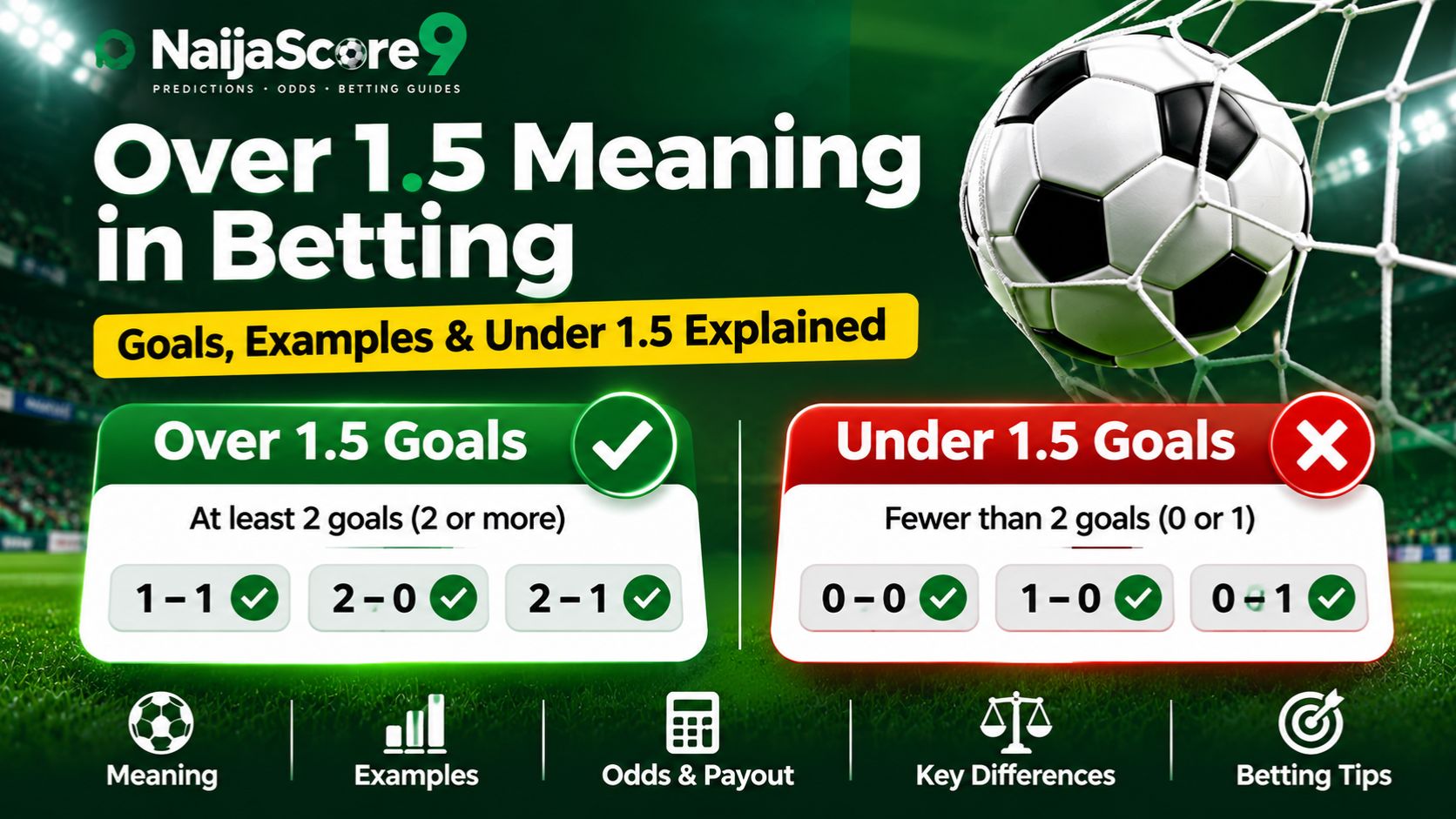
You open a football match on a betting app and see Over 1.5 Goals at odds of 1.30. Another option says Under 1.5 Goals at 3.40.
What exactly are you predicting?
The over 1.5 meaning in betting is simple: you are predicting that at least two goals will be scored in the match. Either team can score them. A 1–1 draw, 2–0 home win or 0–2 away win all count as winning results.
Under 1.5 goals means the opposite. You are predicting that the match will finish with fewer than two goals, so only 0–0, 1–0 and 0–1 qualify.
The important detail is that the standard full-time market counts the combined goals of both teams, not the number of goals scored by your preferred team.
What Does Over 1.5 Mean in Betting?
Over 1.5 means two or more goals must be scored during the specified match period for your bet to win.
For a standard full-time football market, goals scored by the home and away teams are added together. Consider a hypothetical match between Arsenal and Chelsea.
If the final score is:
- Arsenal 2–0 Chelsea: Over 1.5 wins.
- Arsenal 1–1 Chelsea: Over 1.5 wins.
- Arsenal 2–1 Chelsea: Over 1.5 wins.
- Arsenal 1–0 Chelsea: Over 1.5 loses.
- Arsenal 0–0 Chelsea: Over 1.5 loses.
You do not need Arsenal to win. You do not need Chelsea to score. You simply need the total number of valid goals to reach two. That is the essential meaning of over 1.5 in the full-time total-goals market.
Why Is It Called Over 1.5 Instead of Over 2?
The number 1.5 creates a dividing line between one goal and two goals. A football match cannot finish with exactly 1.5 goals.
Therefore:
- Zero goals are below 1.5.
- One goal is below 1.5.
- Two goals are above 1.5.
- Three or more goals are also above 1.5.
This means a standard Over 1.5 bet has no exact-line push or stake refund. It either wins or loses once the market is validly settled. That differs from certain whole-number Asian goal lines, where landing exactly on the line can result in a refund.
Which Football Scores Win Over 1.5 Goals?
The easiest way to understand over 1.5 goals meaning is to compare actual scorelines.
| Final Score | Total Goals | Over 1.5 | Under 1.5 |
| 0–0 | 0 | Loses | Wins |
| 1–0 | 1 | Loses | Wins |
| 0–1 | 1 | Loses | Wins |
| 1–1 | 2 | Wins | Loses |
| 2–0 | 2 | Wins | Loses |
| 0–2 | 2 | Wins | Loses |
| 2–1 | 3 | Wins | Loses |
| 1–2 | 3 | Wins | Loses |
| 3–0 | 3 | Wins | Loses |
| 2–2 | 4 | Wins | Loses |
| 3–2 | 5 | Wins | Loses |
Notice that 2–0 and 1–1 produce the same Over 1.5 result. The way the goals are distributed does not matter in the standard match-total market. A team can score both goals, or the two teams can score once each.
Does 1–1 Count as Over 1.5?
Yes. A 1–1 draw contains two goals: 1 + 1 = 2.
Because two is greater than 1.5, Over 1.5 wins.
Does 1–0 Count as Over 1.5?
No. A 1–0 result contains only one goal.
Even if the winning team dominates possession or creates many chances, the bet loses unless another valid goal is scored during the relevant period.
Does 2–0 Count as Over 1.5?
Yes. The home team has scored twice, bringing the combined match total to two. Both teams do not need to score.
What Does Under 1.5 Mean in Betting?
The under 1.5 meaning is that fewer than two goals must be scored during the specified match period. For a standard full-time market, Under 1.5 wins only when the final score is:
0–0, 1–0 or 0–1.
Any result containing two or more goals loses. For example, suppose Enyimba play a hypothetical match against another NPFL club.
If Enyimba win 1–0, Under 1.5 wins. If the match ends 0–0, Under 1.5 wins.
But if the score finishes 1–1, Under 1.5 loses because the teams have scored two goals between them.
What Is the Difference Between Over 1.5 and Under 1.5?
Over 1.5 requires at least two goals. Under 1.5 requires zero or one goal.
These are opposite selections on the same standard total-goals line. You are not predicting the match winner in either case.
You are predicting the total number of goals.
How Does Over 1.5 Work on a Nigerian Betting Slip?
On a Nigerian sportsbook, you may see the selection displayed as: Over 1.5
O1.5
Total Goals Over 1.5
or:
Over/Under 1.5: Over
These labels usually describe the same full-time goal threshold when they appear under the ordinary match Total Goals market. However, the surrounding market heading matters.
For example:
Match Total Goals Over 1.5 and:
Home Team Total Goals Over 1.5
are not the same bet. One counts both teams.
The other counts only the home team’s goals. Before interpreting a price, check the complete market name.
Full-Time Over 1.5 vs Team Over 1.5 Goals
This is one of the most important distinctions on a football betslip.
Full-Time Match Over 1.5 Goals
Both teams’ goals count.
Example: Arsenal 1–1 Chelsea.
Total goals: 2.
Full-time Over 1.5 wins.
Home Team Over 1.5 Goals
Only the home team’s goals count.
Example: Arsenal 1–1 Chelsea.
Arsenal scored one goal.
Arsenal Team Over 1.5 loses.
Now suppose Arsenal wins 2–0.
Arsenal scored twice.
Arsenal Team Over 1.5 wins.
Away Team Over 1.5 Goals
Only the away team’s goals count.
Example:
Arsenal 1–2 Chelsea.
Chelsea scored twice.
Chelsea Team Over 1.5 wins.
The match also contains three total goals, so ordinary Match Over 1.5 wins.
The lesson is simple: Always identify whether the market refers to both teams combined or one named team.
First-Half Over 1.5 Goals Meaning
A first-half Over 1.5 bet requires at least two goals during the first half.
Goals scored after half-time do not count towards that specific market.
Consider:
Half-time: 1–1
Full-time: 1–1
First-half Over 1.5 wins because two goals were scored before the interval.
Now consider:
Half-time: 0–1
Full-time: 2–1
The match finishes with three goals, but first-half Over 1.5 loses because only one goal was scored before half-time. The full-time Over 1.5 selection wins.
These are different bets.
What Does First-Half Under 1.5 Mean?
It means the first half must finish with zero or one goal.
For example:
- 0–0 at half-time: Wins.
- 1–0 at half-time: Wins.
- 0–1 at half-time: Wins.
- 1–1 at half-time: Loses.
- 2–0 at half-time: Loses.
Second-half goals do not change a first-half market that has already been validly settled.
Second-Half Over 1.5 Goals Meaning
Second-half Over 1.5 requires at least two goals during the second half itself. It does not simply mean the match must finish with two goals overall.
Suppose:
Half-time: 1–0
Full-time: 2–1
Two goals were scored after half-time, so the second-half Over 1.5 wins.
But if:
Half-time: 2–0
Full-time: 2–0
second-half Over 1.5 loses because no goals were scored after the break. The full-time Over 1.5 selection would still win.
This is why the period shown on the betting slip is just as important as the goal line.
Over 1.5 Goals Betting Example in Naira
Suppose a bookmaker offers: Over 1.5 Goals @ 1.35
You stake:
₦2,000
The potential return is calculated using decimal odds:
Stake × Odds = Potential Total Return
₦2,000 × 1.35 = ₦2,700
Your potential profit is:
₦2,700 − ₦2,000 = ₦700
If the match finishes 2–0, 1–1 or any other score with at least two goals, the selection wins under standard settlement rules.
If the match finishes 0–0 or 1–0, you normally lose the ₦2,000 stake.
The ₦2,700 is the gross potential return, including the original stake. Any applicable taxes, deductions or operator-specific conditions may affect the final amount received.
For other stake and odds combinations, NaijaScore9’s betting odds calculator can help distinguish potential return from potential profit.
Over 1.5 vs Over 2.5 Goals: What Changes?
Both markets predict the number of goals in a match, but the required totals differ. Over 1.5 needs at least two goals. Over 2.5 needs at least three goals.
| Final Score | Over 1.5 | Over 2.5 |
| 0–0 | Loses | Loses |
| 1–0 | Loses | Loses |
| 1–1 | Wins | Loses |
| 2–0 | Wins | Loses |
| 2–1 | Wins | Wins |
| 3–0 | Wins | Wins |
| 2–2 | Wins | Wins |
Over 1.5 covers more possible scorelines than Over 2.5. For the same match and settlement period, it will therefore generally be priced at shorter odds.
But shorter odds do not automatically make a selection good value. A lower goal threshold can have a higher probability of winning while still being overpriced relative to the true chance of that outcome.
Over 1.5 vs Both Teams to Score (GG)
In Nigeria, GG commonly refers to Both Teams to Score: Yes.
That market requires each team to score at least once.
Over 1.5 is different.
It only requires two goals in total.
| Final Score | Over 1.5 | GG / BTTS Yes |
| 1–1 | Wins | Wins |
| 2–0 | Wins | Loses |
| 0–2 | Wins | Loses |
| 2–1 | Wins | Wins |
| 3–0 | Wins | Loses |
| 0–0 | Loses | Loses |
A 2–0 result is the clearest example. Over 1.5 wins because two goals were scored. GG lost because only one team scored.
For the standard full-match markets, a successful GG selection necessarily means Over 1.5 has also been reached. But Over 1.5 can win without GG.
Understanding this distinction prevents a common mistake when comparing football goal markets.
Does Over 1.5 Include Extra Time and Penalties?
Standard full-time football goal markets normally settle on 90 minutes plus referee-added stoppage time.
They do not ordinarily include the additional 30 minutes played in knockout matches or a penalty shootout.
For example: A cup match is 1–0 after 90 minutes plus stoppage time.
The score becomes 2–1 after extra time. A standard 90-minute Over 1.5 selection loses because only one goal was scored during its settlement period.
The later goals do not change that result. However, an explicitly labelled extra-time or qualification market may use different rules.
Always check the bookmaker’s settlement period.
Does a Goal in the 90+5th Minute Count?
Yes, for a standard full-time market. Stoppage time is part of normal time.
If the match is 1–0 and a valid second goal is scored at 90+5, Over 1.5 wins under ordinary full-time settlement rules.
Do Penalty Shootout Goals Count?
Not in a standard full-time Over 1.5 market. A penalty awarded and scored during normal playing time counts as a goal.
A successful kick during a post-match penalty shootout does not count towards the ordinary 90-minute match-goals total.
Do Own Goals Count Towards Over 1.5?
Yes, when an own goal is officially awarded and included in the relevant match score.
For example: The score is 1–0.
A defender scores an own goal, making it 1–1.
The match now has two valid goals.
Over 1.5 wins under the standard match-total rules.
The market is concerned with the number of goals credited in the score, not whether they were scored intentionally or by the attacking team.
What Happens if a Goal Is Disallowed by VAR?
A disallowed goal does not count towards the official match total. Suppose the score is 1–0.
A second goal is scored, but VAR rules it out for offside.
The official score remains 1–0. Over 1.5 has not been reached.
The bet would still need another valid goal during the relevant period.
This is why an apparent second goal during a live match should not be confused with a confirmed winning settlement.
What Happens if a Match Is Abandoned?
Abandoned-match rules depend on the bookmaker and whether the relevant market has already been determined.
Suppose a match reaches 2–0 before being abandoned. Two valid goals have already occurred.
Under some bookmaker rules, Over 1.5 can stand as a winning selection because the required goal threshold has already been reached.
Now suppose the match is abandoned at 1–0. The second goal has not occurred.
Depending on the operator’s rules and whether the match is resumed, the selection may be void rather than automatically settled as a loss.
For a fuller explanation of these situations, see NaijaScore9’s guide to what happens when a football match is abandoned.
Is Over 1.5 Goals a Safe Bet?
Over 1.5 is a lower goal threshold than Over 2.5, but that does not make it guaranteed. Every 0–0, 1–0 or 0–1 result loses a standard full-time Over 1.5 selection.
A match can feature plenty of possession, shots and attacking pressure yet finish with one goal or none.
Even a strong favourite can win 1–0. The useful distinction is between probability and certainty.
A selection can be considered more likely than another without being certain to happen.
The price also matters. A bet that wins frequently is not automatically profitable if its odds are too short relative to its true probability.
How to Evaluate Over 1.5 Goals Using Football Statistics
Understanding the meaning of the market is straightforward. Estimating whether a particular match will produce two goals is more complicated.
The following information can provide context, although none of it guarantees the result.
1. Recent Goals Scored and Conceded
Look at how often both teams score and concede. A team with strong attacking numbers may increase the likelihood of goals, but its opponent’s defensive record also matters.
Avoid drawing conclusions from one unusually high-scoring match.
2. Home and Away Performance
Some teams perform very differently depending on the venue. Compare the home team’s scoring record at home with the away team’s record on the road.
A season-wide average can conceal important differences.
3. Percentage of Matches Finishing Over 1.5
Count how many matches reached at least two total goals. For example, if a team played 20 matches and 15 finished with two or more goals:
15 ÷ 20 × 100 = 75%
That is the historical Over 1.5 frequency for that sample. It is not automatically the probability of the team’s next match producing two goals.
The opponent, team news, match conditions and sample quality still matter.
4. Expected Goals (xG)
Expected goals estimates the quality of scoring chances based on a statistical model.
It can help distinguish between a team creating good chances and one relying on unusually efficient finishing.
However, xG is model-dependent and does not guarantee actual goals. A match with strong expected-goals numbers can still finish 0–0.
5. Team News and Tactical Approach
Missing forwards, defensive injuries, fixture congestion and tactical changes can affect the expected number of goals.
A team protecting a narrow lead may approach the final stages differently from one that needs to win.
6. Match Context
A knockout match, relegation battle or late-season fixture may create different tactical incentives.
But avoid assuming that every important match will be defensive or that every rivalry will be high scoring. Use actual evidence rather than narratives alone.
How to Calculate the Implied Probability of Over 1.5 Odds
Decimal odds can be converted into raw implied probability. The formula is:
Implied Probability = 1 ÷ Decimal Odds × 100
Suppose Over 1.5 is offered at:
1.25
Calculation:
1 ÷ 1.25 × 100 = 80%
The price represents a raw implied probability of 80%.
Now consider odds of:
1.40
1 ÷ 1.40 × 100 = approximately 71.43%
These percentages describe the prices, not independently verified true probabilities.
Bookmaker margin can affect the implied probabilities.
To examine a quoted price, use NaijaScore9’s implied probability tools.
Why a Higher Historical Hit Rate Does Not Automatically Mean Value?
Imagine a team has produced Over 1.5 goals in eight of its last ten matches.
That is an 80% historical frequency. It does not prove the next match has an 80% probability.
Even if your carefully estimated probability were 80%, odds of 1.20 would imply approximately 83.33%.
Under that estimate, the offered price would not represent positive expected value.
The market can be likely to win and still be unattractive at the quoted odds.
Over 1.5 Goals in an Accumulator
Over 1.5 selections are sometimes combined with other football markets in accumulators. The combined odds increase as selections are added.
But every required leg normally needs to win. Suppose four independent matches each offer Over 1.5 at:
1.30
The combined decimal odds are:
1.30 × 1.30 × 1.30 × 1.30 = 2.8561
A ₦2,000 stake would have a gross potential return of:
₦2,000 × 2.8561 = ₦5,712.20
That return is available only if all four selections succeed under the applicable rules.
If three matches finish 2–1 and the fourth finishes 1–0, the standard accumulator loses.
There is no partial payout simply because three of the four predictions were correct.
The combined raw implied probability represented by odds of 2.8561 is approximately 35.01%.
This illustrates why several short-priced selections should not automatically be described as a safe accumulator.
NaijaScore9’s accumulator calculator can show how adding selections changes the combined odds and potential payout.
Final Explanation: Over 1.5 vs Under 1.5
The simplest way to remember the difference is: Over 1.5 = Two or more goals.
Under 1.5 = Zero or one goal.
For the standard full-time market, the goals of both teams count together.
A 1–1, 2–0 or 0–2 result wins Over 1.5.
A 0–0, 1–0 or 0–1 result wins Under 1.5.
But the full market label matters. Team totals, first-half totals and second-half totals have different scoring periods or counting rules.
Before evaluating a selection, confirm what the bookmaker is counting, when the market settles and what the odds imply.
Understanding the rule tells you whether a bet wins. Understanding the price and uncertainty helps you judge what that selection actually represents.
Responsible betting: No goal threshold is guaranteed. Do not increase stakes to recover losses, and only participate where legally permitted and within a predetermined affordable limit.