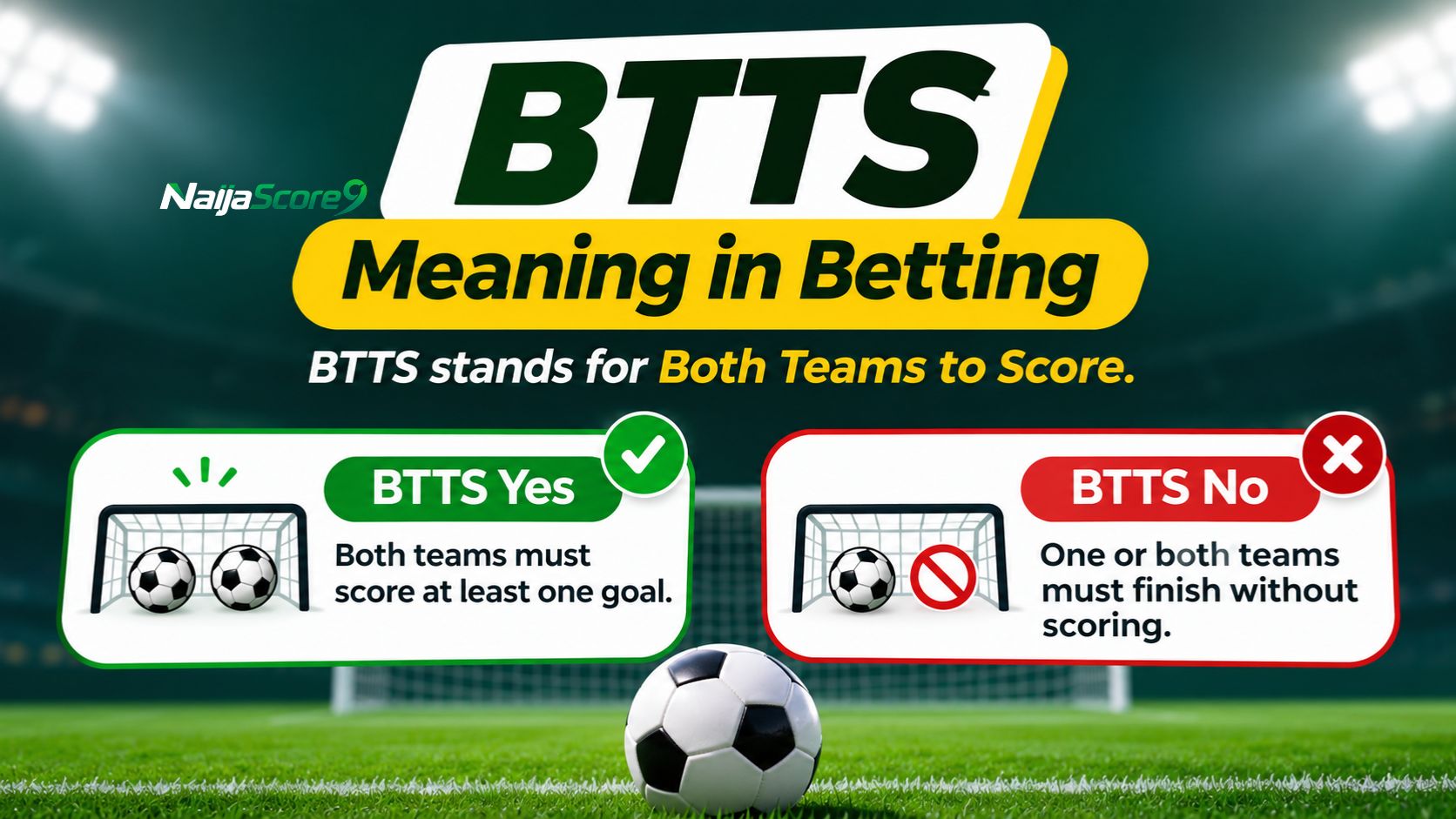
BTTS means Both Teams to Score. In football betting, it is a market where you predict whether both teams will score at least one goal each during a match.
There are two selections:
- BTTS Yes: Both teams must score at least once.
- BTTS No: One or both teams must finish without scoring.
For example, a match ending 2-1 is a winning result for BTTS Yes because both teams scored. A 3-0 result wins BTTS No because only one team scored.
You do not need to predict the match winner or exact score. What matters is whether both sides register a goal during the bookmaker’s specified settlement period, normally 90 minutes plus stoppage time.
What Is BTTS in Betting?
BTTS is short for Both Teams to Score, a football betting market based on whether each team scores rather than who wins the match.
Unlike a standard match-result bet, BTTS has only two possible selections: Yes and No.
Suppose Arsenal play Chelsea in a Premier League match.
If you select BTTS Yes, you are predicting that Arsenal and Chelsea will each score at least one goal.
The following results would satisfy your selection:
- Arsenal 1-1 Chelsea
- Arsenal 2-1 Chelsea
- Arsenal 1-2 Chelsea
- Arsenal 3-2 Chelsea
Arsenal could win, Chelsea could win, or the match could finish in a draw. Your BTTS Yes bet would still win because both teams scored.
However, if Arsenal win 3-0, the same selection loses. Although the match produced three goals, Chelsea failed to score.
This is the central rule of BTTS betting: the goals must come from both teams, not just one.
What Does BTTS Yes Mean?
BTTS Yes means you are predicting that the home team and away team will each score at least one goal during the specified match period.
The goals do not need to arrive in the same half, and both teams do not need to score an equal number.
Consider a hypothetical Nigerian Premier Football League match between Enyimba and Kano Pillars.
You select:
Both Teams to Score: Yes
The match develops as follows:
- 24th minute: Enyimba scores to make it 1-0.
- 67th minute: Kano Pillars equalise to make it 1-1.
- 82nd minute: Enyimba scored again to make it 2-1.
Your BTTS Yes selection has satisfied its scoring requirement once Kano Pillars score the equaliser.
The additional Enyimba goal does not change that.
Whether the final result becomes 2-1, 3-1 or 2-2, both teams have already scored at least once.
A BTTS Yes selection succeeds on results such as 1-1, 2-1, 1-2, 2-2 and 4-1.
It loses on results such as 0-0, 1-0, 0-1, 2-0 and 3-0.
What Does BTTS No Mean?
BTTS No means you are predicting that at least one team will fail to score during the match.
It wins when:
- The home team scores but the away team does not.
- The away team scores but the home team does not.
- Neither team scores.
For example, suppose Shooting Stars play Enyimba and you select BTTS No.
If Shooting Stars win 2-0, your selection wins because Enyimba did not score.
If Enyimba win 0-1, BTTS No also wins because Shooting Stars failed to score.
Even a 0-0 draw produces a winning BTTS No result.
BTTS No does not mean there must be zero goals in the match. It means both teams must not score.
This distinction matters because a high-scoring match can still produce a BTTS No outcome.
For instance, a 4-0 result includes four goals but only one scoring team. Therefore, BTTS No wins.
BTTS Yes vs No: Which Football Scores Win?
The simplest way to understand the meaning of BTTS in betting is to compare common football scores.
The table below shows how standard full-time Both Teams to Score bets are settled.
| Full-time score | BTTS Yes | BTTS No | Explanation |
| 0-0 | Loses | Wins | Neither team scores |
| 1-0 | Loses | Wins | Only the home team scores |
| 0-1 | Loses | Wins | Only the away team scores |
| 1-1 | Wins | Loses | Both teams score once |
| 2-0 | Loses | Wins | Away team fails to score |
| 0-2 | Loses | Wins | Home team fails to score |
| 2-1 | Wins | Loses | Both teams score |
| 1-2 | Wins | Loses | Both teams score |
| 2-2 | Wins | Loses | Both teams score twice |
| 3-0 | Loses | Wins | Only one team scores |
| 3-1 | Wins | Loses | Both teams score |
| 4-0 | Loses | Wins | Four goals, but one scoring team |
| 3-3 | Wins | Loses | Both teams score three times |
The match winner, winning margin and total number of goals are not separate conditions in the standard BTTS market.
One important exception is when BTTS is combined with another selection, such as the match winner or Over 2.5 Goals. Those markets have additional requirements.
What Do GG and NG Mean on Nigerian Betting Sites?
Nigerian betting platforms sometimes display Both Teams to Score using the abbreviations GG and NG.
These terms refer to the same basic Yes/No outcomes:
| Market label | Meaning | Winning condition |
| BTTS Yes | Both Teams to Score: Yes | Both teams score |
| GG | Goal Goal | Both teams score |
| BTTS No | Both Teams to Score: No | At least one team fails to score |
| NG | No Goal | At least one team fails to score |
SportyBet and BetKing use GG/NG terminology in their published football market rules.
What Does GG Mean in Betting?
GG stands for Goal Goal. It normally means both teams must score at least one goal.
For example, if you select GG in an Enyimba vs Remo Stars match and the final score is 1-1, your selection wins.
If the match finishes 2-0, GG loses because Remo Stars failed to score.
What Does NG Mean in Betting?
NG stands for No Goal in the GG/NG market. It means at least one team must finish without scoring.
A 0-0 draw, 1-0 victory or 3-0 victory satisfies the NG selection.
Despite the wording “No Goal”, NG does not require a completely goalless match.
Important: Always check the exact market heading. “No Goal” in a GG/NG market should not be confused with a separate market asking whether a match will contain any goals at all.
Which Goals Count in BTTS Betting?
A BTTS selection is normally settled using the officially recognised goals scored during the bookmaker’s specified match period.
Most standard football BTTS markets cover 90 minutes plus stoppage time.
However, certain match events and market variations require closer attention.
Do Own Goals and Penalties Count?
Yes, own goals generally count towards the team’s official score and therefore towards standard BTTS settlement.
Suppose Arsenal score first against Chelsea to make it 1-0.
Later, an Arsenal defender accidentally turns the ball into Arsenal’s own net.
The official score becomes 1-1 because the own goal is credited to Chelsea.
BTTS Yes wins under standard scoring rules, even though Chelsea’s goal came from an Arsenal player.
The bet concerns the score credited to each team, not which players physically put the ball into the goal.
The same principle applies to penalties scored during normal match play.
If Arsenal lead 1-0 and Chelsea convert a penalty in the 75th minute, both teams have scored and the BTTS Yes condition is satisfied.
A missed penalty does not count, because no goal has been awarded.
Goals ruled out for offside, a foul or another infringement following a VAR review do not count towards BTTS if they are removed from the official match score.
Do Extra Time and Penalty Shootouts Count?
Standard full-time BTTS markets generally include:
- The first 45 minutes.
- First-half stoppage time.
- The second 45 minutes.
- Second-half stoppage time.
They normally exclude extra time and penalty shootouts.
Consider this example from a hypothetical cup fixture:
| Match stage | Score |
| After 90 minutes | 1-0 |
| After extra time | 1-1 |
| After penalties | Home team advances |
For a standard 90-minute BTTS bet, the settlement is BTTS No, because only one team scored during normal time.
The away team’s extra-time equaliser does not change that outcome.
A goal scored in the 90+5th minute, however, counts as part of normal-time stoppage time.
Always check the wording on the bet slip, especially for cup matches where qualification and extra-time markets may be offered separately.
What Happens to BTTS Bets When a Match Is Abandoned?
The treatment of abandoned matches depends on the bookmaker’s rules and whether the BTTS outcome has already been determined.
Consider two different situations.
Situation A: The match is abandoned at 1-1.
Both teams have already scored. Some bookmakers settle BTTS Yes as a winner and BTTS No as a loser because the outcome cannot change through further ordinary scoring.
Situation B: The match is abandoned at 1-0.
Only one team has scored, but the other team might have equalised if play had continued.
Under many bookmaker rules, the unsettled BTTS selections are voided and stakes returned, subject to the operator’s abandonment policy.
For example, bet365’s football rules explicitly distinguish these two scenarios.
Do not assume every operator follows an identical abandonment or postponement policy.
Is BTTS the Same as Over/Under Goals?
No. BTTS and Over/Under Goals are different football betting markets.
BTTS asks whether both teams will score.
Over/Under Goals asks whether the combined number of goals will exceed or remain below a specified total.
For example:
- BTTS Yes: Both teams must score at least once.
- Over 2.5 Goals: The match must produce at least three goals.
- Under 2.5 Goals: The match must produce no more than two goals.
These conditions can produce different results from the same football match.
| Score | BTTS Yes | Over 2.5 Goals |
| 1-1 | Wins | Loses |
| 2-1 | Wins | Wins |
| 3-0 | Loses | Wins |
| 2-2 | Wins | Wins |
| 0-0 | Loses | Loses |
| 4-0 | Loses | Wins |
A 1-1 draw produces BTTS Yes because both teams score, but it contains only two goals, so Over 2.5 loses.
A 3-0 result produces Over 2.5 because three goals are scored, but BTTS Yes loses because one team fails to score.
There are also useful logical relationships between these markets:
- BTTS Yes always satisfies Over 1.5 Goals in a standard football match.
- BTTS Yes does not automatically satisfy Over 2.5 Goals.
- BTTS No does not automatically mean Under 2.5 Goals.
- A BTTS Yes and Under 2.5 Goals combination can only succeed on a 1-1 scoreline.
These distinctions matter when reading combined goal markets. Two selections involving goals may look similar but require different results.
Other Types of BTTS Bets Explained
The standard BTTS market covers whether both teams score during the full-time settlement period.
Bookmakers may also offer versions focused on particular halves or combined with other outcomes. These are separate betting markets with additional conditions.
First-Half and Second-Half BTTS
First-Half BTTS Yes means both teams must score at least once before the first half ends, including first-half stoppage time.
Suppose Arsenal and Chelsea reach half-time at 1-1.
First-Half BTTS Yes wins because both teams scored during the first half.
However, if Arsenal lead 1-0 at half-time and Chelsea equalise in the second half, First-Half BTTS Yes loses even though the full-time score becomes 1-1.
Second-Half BTTS Yes means both teams must each score at least once during the second half.
Goals from the first half do not satisfy the second-half market.
For example, suppose the score is 1-1 at half-time and remains 1-1 until full-time.
The standard full-time BTTS Yes selection wins.
Second-Half BTTS Yes loses because neither team scored after half-time.
BTTS in Both Halves
BTTS in Both Halves is more demanding than standard full-time BTTS.
For a Yes selection to win, both teams must score at least one goal in each half.
Example:
- First half: Arsenal 1-1 Chelsea.
- Second-half goals: Arsenal 1, Chelsea 1.
- Final score: Arsenal 2-2 Chelsea.
BTTS in Both Halves wins because each team scored in both periods.
Now consider another match finishing 2-2:
- Half-time score: 0-0.
- Second-half goals: Arsenal 2, Chelsea 2.
- Final score: 2-2.
Standard BTTS Yes wins, but BTTS in Both Halves Yes loses because neither team scored in the first half.
The final score alone is therefore insufficient to assess this market. You must check when the goals occurred.
BTTS and Match Result or Over/Under
Some bookmakers combine BTTS with another selection.
For example, Home Win and BTTS Yes requires the home team to win and both teams to score.
If Enyimba beat Kano Pillars 2-1, the combination succeeds.
If Enyimba wins 2-0, it loses because Kano Pillars did not score.
Similarly, BTTS Yes and Over 2.5 Goals requires both teams to score and the match to contain at least three goals.
A 2-1 result satisfies both conditions.
A 1-1 result satisfies BTTS Yes but fails Over 2.5 Goals, so the combined selection loses.
These are not interchangeable with ordinary BTTS Yes or No bets. The exact combinations and settlement rules must be checked before interpreting a selection.
How Do BTTS Odds and Payouts Work?
BTTS Yes and BTTS No are priced separately by bookmakers.
The available decimal odds determine the potential return if your selection wins. They also reflect the bookmaker’s assessment of the outcome, including its pricing margin.
Consider a hypothetical match between Arsenal and Chelsea.
| Selection | Illustrative decimal odds |
| BTTS Yes | 1.85 |
| BTTS No | 2.05 |
Suppose you stake ₦2,000 on BTTS Yes at 1.85.
The potential total return is:
₦2,000 × 1.85 = ₦3,700
Your net profit, after subtracting the original stake, would be:
₦3,700 − ₦2,000 = ₦1,700
If the match ends 2-1, your BTTS Yes selection wins and the return is ₦3,700.
If the match finishes 2-0, your selection loses and the ₦2,000 stake is lost.
Now suppose you instead place ₦2,000 on BTTS No at 2.05.
If the match ends 2-0, the total return would be ₦4,100, including a ₦2,100 net profit.
These odds are illustrative, not current bookmaker prices.
The available odds do not guarantee a result. For example, odds of 1.85 imply a raw break-even probability of approximately 54.05%, before adjustments for bookmaker margin.
You can learn how decimal prices relate to returns and probabilities in NaijaScore9’s guide to what betting odds mean.
When Is a BTTS Bet Decided?
There is an important difference between when a BTTS outcome becomes mathematically certain and when the bookmaker actually settles the selection.
When BTTS Yes Is Already Determined
Suppose a match is 1-1 after 60 minutes.
Both teams have scored.
Under the standard full-time BTTS rules, the Yes requirement has already been met. Additional goals cannot undo that condition.
However, the bookmaker may not credit the winnings immediately. Settlement can depend on the operator’s processing rules, official event confirmation and how the match concludes.
When BTTS No Is Already Lost
Suppose you selected BTTS No and the score reaches 1-1.
Your selection’s losing condition has been met because both teams have scored.
Even if the match ends 5-1, BTTS No remains unsuccessful.
When BTTS No Can Be Confirmed as a Winner
Suppose a match is 1-0 with five minutes remaining.
BTTS No is still not a confirmed winning result because the trailing team could equalise during the remaining minutes.
If the score stays 1-0 until the end of the applicable settlement period, BTTS No wins.
This difference also matters when viewing in-play markets. A standard live full-match BTTS market generally concerns the complete match score, while a separately labelled “rest of match” or period-specific market may count only subsequent goals.
Always verify which period the live selection covers before interpreting its outcome.
Common Mistakes When Reading BTTS Markets
Even though the market has only Yes and No selections, several misunderstandings can produce incorrect expectations.
- Assuming BTTS Yes requires a draw
A draw is not necessary. Scores such as 2-1, 3-1 and 1-2 all qualify because both teams scored.
- Thinking BTTS No means 0-0
BTTS No includes goalless draws, but it also wins on 1-0, 2-0, 3-0 and other results where one team fails to score.
- Confusing BTTS with Over 2.5 Goals
A match can produce three or more goals without both teams scoring. A 3-0 result is the clearest example.
- Assuming goals in extra time always count
The standard full-time BTTS market normally ends after 90 minutes plus stoppage time. Extra time and shootouts are separate unless the bookmaker states otherwise.
- Treating every BTTS market as identical
Full-time BTTS, first-half BTTS, second-half BTTS and BTTS in both halves have different scoring requirements.
Always read the complete selection label.
- Assuming a BTTS prediction is guaranteed because the teams usually score
BTTS remains uncertain even when both teams have strong recent scoring records. An official result of 1-0 still loses a Yes selection regardless of the pre-match statistics.
Understanding the market’s meaning is separate from deciding whether any particular wager is worthwhile.
Final Thoughts
The meaning of BTTS in betting is simple: Both Teams to Score.
BTTS Yes wins when both teams score at least once. BTTS No wins when one or both teams finish without scoring.
The match winner is irrelevant in the standard market. A 2-1 win, 1-1 draw and 3-2 defeat all qualify for BTTS Yes, while 0-0, 1-0 and 3-0 qualify for BTTS No.
The main details to check are the exact market label, the applicable match period and the bookmaker’s settlement rules.
If you already understand the market and want to examine actual fixtures, NaijaScore9 provides a separate page for today’s BTTS tips and football odds, where the focus is on available matches rather than terminology.
Betting outcomes are uncertain. Only participate if you meet the applicable legal age requirements, use affordable limits and follow NaijaScore9’s responsible betting guidance.