
You place:
₦5,000 on a football team at odds of 3.00.
Your potential return is:
₦15,000.
The team scores early, its live odds shorten dramatically, and your sportsbook suddenly offers:
Cash Out: ₦9,200.
Where did ₦9,200 come from?
Why not ₦10,000? Why not the full ₦15,000? And why can the figure change several times within one minute?
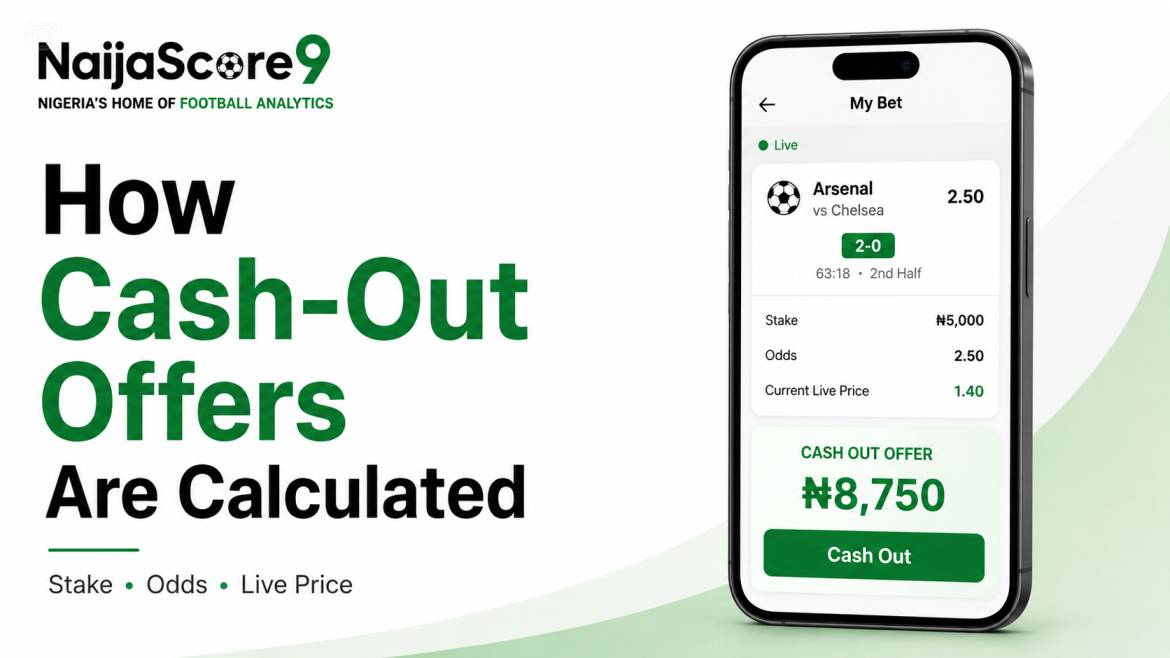
A cash-out offer is essentially the sportsbook’s current price for settling your open bet before the final result is known. The operator reassesses what your ticket is worth under current market conditions and offers an amount for closing the position early.
For a typical sportsbook, the calculation is influenced by:
- your original stake;
- the odds you originally accepted;
- your potential return;
- the current odds of the selection;
- how much of the event remains;
- what has happened in-play;
- the current prices of the other relevant outcomes;
- the bookmaker’s own cash-out pricing and margin.
Bet365 currently states that its cash-out amount considers criteria including the current price available, amount staked and original price taken. Betfair similarly says sportsbook cash-out values fluctuate according to the current likelihood of the bet winning and are based on live market prices.
That gives us the most important principle:
Cash out is not a fixed percentage of your potential winnings. It is a live valuation of your remaining betting position.
Understanding that makes the changing number much easier to interpret.
What Does Cash Out Mean in Betting?
Cash Out allows you to settle an eligible bet before the event or complete accumulator has finished.
Suppose your ticket could eventually return:
₦20,000
but the sportsbook currently offers:
₦13,500 cash out.
If you accept:
₦13,500 becomes your settlement amount.
You no longer receive the original ₦20,000 if the bet later wins.
Likewise, if the selection later loses, you normally retain the accepted cash-out settlement.
Bet365 explains that once a successful cash-out is accepted, the bet is settled early and the eventual result no longer affects the amount returned.
So cashing out changes your original contract.
You are exchanging:
uncertain future return
for:
a smaller known amount now.
The Four Numbers Behind Most Cash-Out Offers
To understand a cash-out value, start with four figures.
| Factor | Why It Matters |
| Original stake | Determines how much capital you initially risked |
| Original odds | Determines the price at which you entered |
| Potential return | Shows the maximum contractual return if the bet wins |
| Current market odds | Reflect how the market now prices the remaining outcome |
For a single bet:
Potential Return = Original Stake × Original Odds
If you placed:
₦5,000 @ 3.00
then:
Potential Return = ₦15,000
The sportsbook then considers how valuable the right to that ₦15,000 looks now, given the latest market price.
A Simple Way to Estimate Cash-Out Value
Sportsbooks generally do not publish one universal exact cash-out formula.
Their calculations are proprietary and can include margin, live data, market suspension rules and other adjustments.
However, you can understand the mechanics using a hedge-equivalent approximation.
Suppose:
Original stake: ₦5,000
Original odds: 3.00
Potential return:
₦15,000
Your team scores and its current odds shorten to:
1.60
A simplified theoretical current value of the original payout can be estimated as:
Potential Return ÷ Current Odds
So:
₦15,000 ÷ 1.60 = ₦9,375
That tells us why a cash-out offer might now be somewhere around that region.
The actual sportsbook might display:
₦9,050
or:
₦9,200
rather than exactly ₦9,375.
Why?
Because the sportsbook is not required to offer a perfectly margin-free hedge-equivalent value.
Its own pricing, current opposite-side markets, margin, live risk and available data can influence the offer.
So this formula should be treated as:
a useful estimate
rather than:
the sportsbook’s exact hidden formula.
Why the Cash-Out Offer Is Usually Below the Full Potential Return?
Suppose:
Potential return: ₦15,000
Your cash-out offer:
₦9,200
Some users ask:
“If my team is winning, why won’t they give me the full ₦15,000?”
Because the match has not finished.
There is still a probability that your selection loses.
The original ₦15,000 is payable only if the contract is completed successfully.
The ₦9,200 offer reflects the fact that the current position is valuable—but not certain.
If the remaining winning probability rises further, the cash-out value can move closer to the full potential return.
If the position becomes less favourable, the offer can fall.
Why Cash-Out Value Rises When Your Odds Shorten?
Suppose you back:
Team A @ 4.00
Stake:
₦5,000
Potential return:
₦20,000
Before kick-off, Team A’s price shortens to:
2.00
That means the market now assigns a much higher probability to Team A than when you placed the original bet.
Your original ticket has therefore become more valuable.
A simple theoretical valuation:
₦20,000 ÷ 2.00 = ₦10,000
The sportsbook’s actual offer might be somewhat below that.
But the direction makes sense:
Original odds 4.00 → current odds 2.00 → cash-out value rises
You entered at a substantially better price than is now available.
This is closely related to why market movement matters. NaijaScore9’s guide to why football odds move before kick-off explains the main information and market forces behind those changes.
Why Cash-Out Value Falls When Your Odds Drift?
Now reverse the situation.
Original bet:
₦5,000 @ 2.00
Potential return:
₦10,000
Current market odds move to:
4.00
The market now considers your selection much less likely to win.
Simple theoretical value:
₦10,000 ÷ 4.00 = ₦2,500
The sportsbook might offer:
₦2,200
or:
₦2,350
depending on its pricing.
You originally risked:
₦5,000
but may now be offered less than half of it because the probability of your ticket succeeding has deteriorated.
Bet365 explicitly notes that changes in market price and in-play action can result in a cash-out amount below the original stake.
A Football Example: Cash Out After an Early Goal
Suppose you place:
₦10,000 on Home Win @ 2.50
Potential return:
₦25,000
The home team scores after 15 minutes.
Its live price moves to:
1.45
Simple theoretical valuation:
₦25,000 ÷ 1.45 ≈ ₦17,241
A sportsbook might offer something such as:
₦16,500–₦17,000
depending on its own pricing.
You then have two choices.
Let the Bet Run
Potential result:
Win → ₦25,000 return
Lose → ₦0 return
Accept Cash Out
Potential result:
Receive the displayed cash-out amount now
You sacrifice part of the potential upside in exchange for eliminating the remaining uncertainty on the settled position.
That is the economic trade-off.
The Current Score Is Not the Only Thing That Matters
Two matches can have the same score but very different cash-out values.
Consider:
Team A leads 1–0
Match 1
Minute:
22
There is still a long time remaining.
Match 2
Minute:
88
Very little time remains.
Even if the same team was originally priced at identical odds, the cash-out values will usually be very different.
Why?
Because the remaining probability of the opponent recovering is much smaller in minute 88.
Cash-out calculations therefore react to:
- score;
- match time;
- red cards;
- penalties;
- possession and live market information;
- available current odds.
The sportsbook ultimately translates that changing match situation into new market prices.
A Red Card Can Change the Cash-Out Offer Instantly
Suppose your team leads:
1–0
and your cash-out offer is:
₦12,500
Then one of your team’s defenders receives a red card.
The market quickly recalculates the chance of:
- your team winning;
- a draw;
- the opponent winning.
Your team’s odds may immediately drift.
Cash-out value can fall with them.
This is why the button can change significantly even when the actual score remains exactly the same.
The scoreboard is only one input into the market’s probability assessment.
Why Cash-Out Offers Change Before Kick-Off?
Cash out is not only an in-play feature.
Some sportsbooks offer it before the match begins.
Suppose you place:
Team A @ 3.00 on Monday
By Saturday:
Team A @ 2.30
Possible reasons include:
- injury news affecting the opponent;
- stronger expected line-up;
- market activity;
- new information;
- broader bookmaker repricing.
Your original 3.00 ticket is now better than the 2.30 price available to new bettors.
That can create a positive pre-match cash-out value.
If the market instead moves:
3.00 → 3.60
your ticket has become less valuable and the cash-out offer may fall below your original stake.
This is one practical reason the difference between opening odds and closing odds matters.
Why the Sportsbook Offer Can Be Lower Than a Manual Hedge?
Suppose your original ticket could return:
₦20,000
and the opposite market allows you to manually hedge into a position worth approximately:
₦11,000
But the sportsbook offers:
₦10,400 cash out.
That difference can represent part of the operator’s pricing for providing the convenience of immediate settlement.
The cash-out button is not necessarily designed to give you the maximum theoretical hedge value available across the entire market.
It is an offer.
You can:
accept it
or:
reject it and keep the original bet open.
This is why cash out should be treated like another price rather than automatically accepted whenever it appears.
Cash Out vs Hedging a Bet
These concepts are related but not identical.
Cash Out
The sportsbook:
- calculates the offer;
- displays one settlement amount;
- closes the eligible position when accepted.
Manual Hedge
You:
- keep the original bet;
- place a second complementary bet;
- choose how much risk to reduce.
The second method gives more control but requires:
- another stake;
- correct calculation;
- genuinely matching markets.
NaijaScore9’s guide on how to hedge a bet explains full and partial hedge calculations in detail.
A useful rule is:
A cash-out offer can be compared with what a manual hedge would achieve before deciding whether the convenience is worth the price.
How Cash Out Is Calculated on an Accumulator?
Accumulator cash out is more complicated because the ticket contains several selections.
Suppose you place:
₦2,000 four-leg accumulator
Potential return:
₦24,000
Three legs have already won.
Only:
Team A @ original accumulator leg price
remains.
The sportsbook effectively values the ticket based largely on the probability of that final active leg succeeding.
Suppose the remaining selection is currently:
1.60
A rough theoretical value would be:
₦24,000 ÷ 1.60 = ₦15,000
The actual cash-out offer could be lower.
If the remaining team’s price shortens to:
1.25
the theoretical value moves towards:
₦24,000 ÷ 1.25 = ₦19,200
As the final leg becomes more likely to win, the ticket becomes more valuable.
Why Accumulator Cash-Out Values Can Move So Fast?
If several accumulator legs are still being played simultaneously, every relevant price can change.
Imagine a four-leg ticket:
- Team A winning;
- Team B drawing;
- Team C winning;
- Team D losing.
The sportsbook must continuously revalue the probability that all remaining required conditions will succeed together.
One goal in any fixture can cause the ticket’s cash-out offer to jump or collapse.
This is one reason accumulators produce much greater outcome volatility than individual singles. See NaijaScore9’s guide to single bets vs accumulators for the probability mechanics behind that difference.
Why a Losing Accumulator Can Still Show a Cash-Out Offer?
Suppose three legs have already won but your final selection is losing:
0–1 in the 60th minute
The accumulator is not dead yet.
The team can still recover.
If the market assigns the team some probability of eventually satisfying the selection, your ticket still has economic value.
The sportsbook may therefore offer:
₦1,800
even though your original accumulator could return:
₦20,000
The offer reflects the reduced probability of reaching that full payout.
If the team’s situation deteriorates further, the value can approach zero.
Why Cash Out Can Disappear?
Cash Out is not guaranteed to remain available.
Bet365 says a cash-out request can fail if prices change or the market becomes suspended while the request is being processed. Betfair similarly states that live prices move continuously and that cash-out requests may fail or return a revised amount.
Common reasons include:
- goal being scored;
- penalty review;
- red-card incident;
- VAR decision;
- market suspension;
- major odds movement;
- technical or data-feed issue;
- market no longer being eligible;
- insufficient liquidity in exchange-based products.
This is why you should never place a bet on the assumption:
“I can always cash out later.”
The feature may not be available when you need it.
Why the Offer Can Change Between Clicking and Confirming?
Suppose the button displays:
₦8,420
You click it.
Before confirmation finishes, the market changes.
You may receive:
- a new amount;
- a failed request;
- no cash-out execution.
Betfair explicitly warns that cash-out amounts are not guaranteed because live market prices constantly move.
This is especially relevant in football because prices can move dramatically immediately after:
- goals;
- penalties;
- red cards;
- late attacks.
The value shown is a live quote, not necessarily a guaranteed price until the request is successfully accepted.
What Is Partial Cash Out?
Partial Cash Out lets you settle only part of the position.
Suppose your full cash-out offer is:
₦12,000
You might instead choose to cash out only part of the ticket.
This can:
- secure some money;
- leave some potential upside active;
- reduce rather than eliminate risk.
Betfair’s exchange documentation states that partial cash-out amounts depend on factors including the original stake and odds, current odds and the portion previously cashed out; available liquidity can also affect the values offered.
Partial cash out is conceptually similar to a partial hedge.
You are not fully exiting the position.
You are reducing exposure.
A Cash-Out Offer Above Your Stake Is Not Automatically Profit You Should Take
Suppose:
Stake: ₦5,000
Cash Out:
₦6,200
If accepted:
Realised profit = ₦1,200
That is genuine positive settlement relative to the original stake.
But the decision should still consider what you are giving up.
Suppose your potential return is:
₦15,000
and your updated analysis says the selection still has a very strong chance of winning.
Accepting ₦6,200 may be overly expensive protection.
The fact that the offer is green or above your stake does not automatically make it good value.
A Cash-Out Offer Below Your Stake Is Not Automatically Bad
Suppose:
Stake: ₦10,000
Current cash out:
₦6,500
Your position has deteriorated.
You receive new information suggesting the original selection is now substantially weaker than you first believed.
Accepting ₦6,500 would realise:
−₦3,500
rather than risking:
−₦10,000
That can be a rational loss-limiting decision.
The right comparison is not:
Cash Out vs Original Stake
alone.
It is:
Cash Out vs the current expected value and risk of leaving the bet open.
How to Judge Whether a Cash-Out Offer Is Fair?
You do not need access to the sportsbook’s internal algorithm.
Use a practical comparison.
Step 1: Calculate the Original Potential Return
Example:
₦5,000 × 3.00 = ₦15,000
Step 2: Find the Current Comparable Odds
Suppose:
1.60
Step 3: Estimate the Theoretical Current Position Value
₦15,000 ÷ 1.60 = ₦9,375
Step 4: Compare the Sportsbook Offer
Suppose:
Cash Out = ₦8,950
Difference from simple estimate:
₦425
That difference does not automatically prove the offer is unfair because our calculation is simplified.
But it gives you useful context.
Step 5: Compare With a Manual Hedge
If a genuinely complementary market allows you to reduce the same risk more efficiently, you can compare the two choices.
Step 6: Decide What Risk You Actually Want
Do you want:
- full exit;
- partial protection;
- maximum upside?
The cash-out button is only one possible risk-management choice.
Cash-Out Percentage Can Be Misleading
Some bettors evaluate cash out like this:
Potential return: ₦20,000
Cash-out offer: ₦15,000
Therefore:
“They’re offering 75%, so that must be good.”
That percentage alone tells you very little.
Suppose the selection now has a:
90% probability of winning.
A ₦15,000 settlement against a possible ₦20,000 payout may be unattractive.
Now suppose the selection has only a:
50% probability.
The same ₦15,000 offer would look very different.
Always connect the cash-out amount to current probability, not merely potential return.
Why Cash-Out Decisions Should Use Probability, Not Fear?
The match enters the 85th minute.
Your team leads 1–0.
The sportsbook offers:
₦18,000
against a possible:
₦20,000
Many users think only:
“What if they concede?”
That is understandable, but it is not analysis.
Ask instead:
- What probability does the current market assign to my selection?
- What price am I paying to eliminate the remaining risk?
- How important is the guaranteed amount to me?
- Would I make the same decision without seeing the match emotionally?
Cash out is a risk-management tool.
It should not become a button pressed automatically whenever the final few minutes feel uncomfortable.
Cash Out Can Affect Bonus or Promotion Progress
If a wager was placed as part of a promotion, accepting Cash Out can affect whether it continues to qualify.
Betfair currently warns that cashed-out bets may be removed from qualifying promotional wagering depending on the relevant offer terms.
So before cashing out a promotional wager, check:
- qualifying-bet conditions;
- wagering requirement;
- bonus terms;
- cash-out exclusions.
If you are using a bonus with rollover conditions, see NaijaScore9’s guide to wagering requirements in betting bonuses.
Free Bets Can Produce Different Cash-Out Behaviour
Free-bet stakes are promotional value rather than ordinary cash.
That can affect the cash-out calculation.
Betfair currently explains that a free-bet cash-out value can show zero when the calculated cash-out amount has not exceeded the value of the free-bet stake, because that promotional stake is not included in ordinary returns.
Bet365 similarly states that Cash Out on a bet placed with Bet Credits is available only when the cash-out amount exceeds the value of the Bet Credits used.
This is another reason cash bets and promotional bets should not be assumed to behave identically.
Common Cash-Out Calculation Mistakes
Mistaking Potential Return for Profit
If:
Stake = ₦5,000
Potential return = ₦15,000
your potential profit is:
₦10,000
not ₦15,000.
Assuming Cash Out Is a Fixed Percentage
It changes with current market probability.
Looking Only at the Score
Time remaining, cards and market prices matter too.
Assuming the Sportsbook Uses a Public Universal Formula
Operators use their own calculation systems.
Treating the Simple Hedge Formula as Exact
Potential Return ÷ Current Odds is a useful approximation—not a guaranteed sportsbook quote.
Assuming Cash Out Will Always Be Available
It can disappear during market suspensions or other conditions.
Automatically Cashing Out Every Winning Bet
This can systematically cut upside while leaving losing bets exposed.
Ignoring Promotional Rules
Cash out can affect bonus qualification.
Comparing Different Markets
The current odds used for comparison should represent the same underlying contract.
Conclusion
The clearest way to understand cash out is to stop viewing the button as a reward.
It is a price.
You originally purchased a betting position at one set of odds.
As the market changes, that position becomes more or less valuable.
The sportsbook then offers an amount to take that position off your hands before the event is fully settled.
If you placed:
₦5,000 at 3.00
your maximum return is:
₦15,000.
If the same selection later trades around:
1.60
your original ticket is much more valuable because you hold 3.00 on an outcome the market now prices substantially shorter.
A simple theoretical calculation:
₦15,000 ÷ 1.60 = ₦9,375
helps explain why a cash-out offer might appear somewhere near that amount.
But the exact sportsbook offer can differ because operators use their own models, current prices and margins. Bet365 confirms that current price, original price and stake are among the factors used, while Betfair describes its sportsbook cash-out offers as real-time values based on live market prices and the current likelihood of winning.
That leaves three meaningful choices:
keep the original position,
accept the sportsbook’s cash-out price,
or:
manage the exposure another way, such as a calculated hedge where suitable.
The correct choice does not come from asking:
“Is my cash-out offer bigger than my stake?”
Ask instead:
“What is my bet worth now, what future upside am I surrendering, and how much risk am I removing in exchange?”
That is the useful way to evaluate Cash Out.
It also explains why blindly cashing out every winning ticket can be expensive: each time, you are paying a price to transfer the remaining uncertainty back to the sportsbook.
Use Cash Out when the certainty is worth that price—not simply because the button is available.