
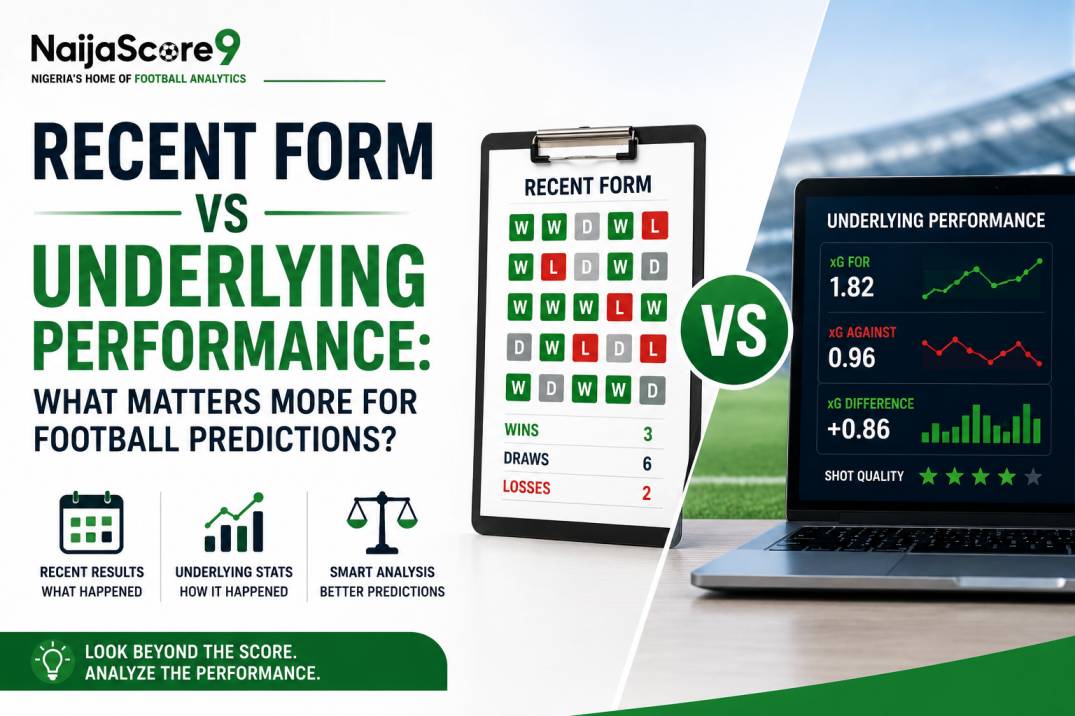
A team has won four of its last five matches.
Another has won only once in the same period.
At first glance, the first team looks like an obvious prediction.
But now look beneath the results.
The team with four wins has repeatedly been outshot, allowed several high-quality chances and scored from a small number of opportunities. The team with one win has controlled matches, created better chances than its opponents and repeatedly failed to convert them.
Which team is actually playing better football?
That is the problem with relying on recent form alone.
Form tells you what happened recently. It does not always tell you whether those results were produced by performances that are likely to continue.
Underlying performance tries to answer that second question.
It considers whether a team’s results are supported by factors such as:
- quality of chances created;
- quality of chances conceded;
- expected goals;
- shot locations;
- territorial control;
- opponent strength;
- home and away performance;
- player availability;
- tactical changes.
For football predictions, neither recent form nor underlying data should be used in isolation.
But when the two strongly disagree, repeatable underlying performance usually deserves more weight than a short sequence of wins or losses—unless something has genuinely changed in the team that makes the recent matches more representative of its current level.
That final qualification matters.
A team’s last five games should not simply be ignored because season-long statistics look stronger. If a new manager, different formation, important injury or returning striker has materially changed the way the team plays, recent performance may contain information that older matches no longer capture.
The objective is therefore not to choose between “form” and “data.”
It is to determine:
Which recent information is signal, and which is simply short-term result noise?
What Does Recent Form Actually Mean?
Recent form usually refers to a team’s latest results.
You might see:
W – W – D – W – L
or:
4 wins from the last 5 matches
This can be useful because football teams change.
A season-long average may contain matches played:
- under a previous manager;
- with a different goalkeeper;
- before an important striker returned;
- before a tactical change;
- during an injury crisis.
Recent matches can therefore provide information about what the team looks like now.
The problem is that the usual form table reduces every match to one of three letters:
W, D or L.
It does not tell you whether the win was convincing.
A 1–0 victory could involve:
- complete domination and several missed chances;
or:
- one shot on target while the opponent missed three excellent opportunities.
Both appear as:
W
in the form table.
For prediction purposes, those performances should not necessarily be treated equally.
What Is Underlying Performance?
Underlying performance refers to the football actions and statistical indicators behind the final result.
Depending on the analysis, useful measures can include:
- expected goals for;
- expected goals against;
- non-penalty xG;
- shots;
- shots from dangerous areas;
- big chances;
- box entries;
- possession in useful areas;
- defensive pressure;
- field position;
- set-piece threat.
The purpose is not to collect as many statistics as possible.
It is to understand whether the team consistently creates conditions associated with scoring goals and preventing opponents from doing the same.
Suppose Team A has:
Last 5 results: W – W – W – D – W
but averages:
1.05 xG created
1.72 xG conceded
Team B has:
Last 5 results: L – W – D – L – D
but averages:
1.71 xG created
0.91 xG conceded
The results strongly favour Team A.
The underlying chance balance strongly favours Team B.
That disagreement deserves investigation before predicting either team’s next fixture.
Why Recent Results Can Mislead You?
Football contains considerable short-term variance.
A team does not need to produce the better performance to win one individual match.
Consider this result:
Team A 2–0 Team B
The score suggests a comfortable victory.
Now suppose the expected goals were:
Team A: 0.76 xG
Team B: 1.91 xG
Team A converted two relatively difficult opportunities.
Team B missed several stronger chances.
The result is real. The three league points belong to Team A.
But if you are trying to predict what happens next, the quality of the performance matters.
NaijaScore9’s guide to using expected goals in football match analysis explains why chance quality can reveal information that the final score hides.
A Winning Streak Can Contain Weak Performances
Imagine a team wins five consecutive league matches:
| Match | Result | xG For | xG Against |
| 1 | 1–0 | 0.70 | 1.20 |
| 2 | 2–1 | 1.05 | 1.55 |
| 3 | 1–0 | 0.65 | 1.38 |
| 4 | 2–0 | 0.91 | 1.44 |
| 5 | 1–0 | 0.79 | 1.10 |
Results:
5 wins from 5
Goals:
7 scored, 1 conceded
But total xG:
4.10 created
6.67 conceded
A normal form table makes this look like one of the strongest teams in the competition.
The underlying numbers suggest a team that has repeatedly allowed the better chances but benefited from:
- excellent finishing;
- excellent goalkeeping;
- opponent misses;
- favourable match incidents.
That does not mean:
“The team must lose next.”
It means:
“The five-match winning streak probably overstates the quality of the football being produced.”
That is a more useful prediction conclusion.
Poor Results Can Also Hide Strong Performances
Now consider the opposite.
| Match | Result | xG For | xG Against |
| 1 | 0–1 | 1.55 | 0.72 |
| 2 | 1–1 | 1.84 | 0.90 |
| 3 | 1–2 | 2.10 | 1.01 |
| 4 | 0–0 | 1.47 | 0.58 |
| 5 | 2–1 | 1.72 | 0.88 |
Results:
1 win from 5
That looks poor.
But the team generated:
8.68 xG
and conceded only:
4.09 xG
Its performances have generally produced better chances than its opponents.
The immediate conclusion should not be:
“Back this team because regression is guaranteed.”
Football does not work that neatly.
Instead, ask why results have lagged behind performance.
Possible explanations include:
- short-term finishing variance;
- weak striker quality;
- exceptional opposition goalkeeping;
- recurring defensive mistakes;
- poor set-piece defending;
- genuinely poor finishing ability.
Underlying statistics identify the discrepancy.
Football analysis still has to explain it.
So Which Matters More: Recent Form or Underlying Performance?
For most predictive analysis, underlying performance is the stronger starting point because it tries to measure processes that can repeat rather than simply recording outcomes that already occurred.
But recent form becomes more valuable when it reflects a genuine change in those underlying processes.
A practical hierarchy is:
Recent results alone → useful but noisy
Recent underlying performance → more informative
Underlying performance adjusted for current team context → stronger
The key is not how recent the result is.
The key is whether the reason behind that result is likely to exist again in the upcoming match.
When Recent Form Deserves More Weight?
There are situations where the latest matches genuinely tell you something that season averages do not.
1. A New Manager Has Changed the Team
Suppose a club played 20 matches under one coach and then changed manager.
The new manager introduces:
- a different pressing structure;
- a higher defensive line;
- a new formation;
- different attacking roles.
The season-long xG average now contains a large amount of football produced under a system that no longer exists.
In that situation, the most recent matches deserve more weight.
But do not simply say:
“New manager = three wins.”
Check whether the performances changed too.
Did the team begin:
- creating more chances;
- conceding fewer chances;
- progressing the ball differently;
- controlling more territory?
If both results and underlying performance improve, the change becomes much more convincing.
2. Important Players Have Returned
Suppose a team’s poor six-week run occurred without:
- its first-choice striker;
- main creative midfielder;
- best centre-back.
All three return.
The team’s older strong performances may suddenly become more relevant than its recent injury-affected results.
The same works in reverse.
A team’s five-match winning sequence becomes less useful if the players responsible for those performances will not play in the next fixture.
3. A Tactical Change Is Clearly Working
Perhaps a team switches from:
4-2-3-1
to:
3-4-2-1
and immediately begins creating higher-quality central chances while conceding fewer transitions.
That is meaningful recent information.
Do not ignore it simply because a full-season average says the team is mediocre.
Football models should respond when the football itself changes.
4. The Team’s Schedule Has Changed
Recent form can improve simply because the opponents became easier.
Suppose:
Five previous opponents: 1st, 3rd, 4th, 6th, 8th
followed by:
Five recent opponents: 14th, 16th, 17th, 18th, 20th
A sudden winning run may partly reflect schedule strength rather than genuine improvement.
Likewise, a strong team can look out of form after a difficult run of fixtures.
Always ask:
Who produced these recent results against?
Opponent Strength Is Essential
A raw five-match form table treats every opponent equally.
But:
Winning away against the league leader
should not necessarily carry the same analytical meaning as:
beating the bottom team at home
Likewise, producing:
1.5 xG
against an elite defence can be more impressive than producing:
2.0 xG
against the weakest defensive side in the league.
When evaluating underlying performance, consider the level of opposition behind the numbers.
A useful prediction model should reward strong performances against strong teams rather than relying on raw averages alone.
Home and Away Form Need to Be Separated
Suppose a team’s overall recent form is:
W – W – W – D – W
That looks excellent.
But its last five away matches are:
L – D – L – W – L
The upcoming fixture is away.
The overall form line can therefore be misleading.
Now check the underlying split:
Home
2.00 xGF
0.85 xGA
Away
1.02 xGF
1.60 xGA
That is a substantial difference.
For match prediction, use the context that most closely resembles the upcoming fixture.
A team’s home performance should not automatically be transferred to an away match.
xG Can Help Separate Result Form From Performance Form
One useful distinction is:
Result form
versus:
performance form
Result form might be:
W – W – D – W – W
Performance form could include:
- xG difference;
- chance creation;
- chance prevention;
- non-penalty xG;
- shot quality.
Consider:
Team A
Recent record:
13 points from 15
Recent xG difference:
−2.4
Team B
Recent record:
5 points from 15
Recent xG difference:
+3.1
The result table favours Team A.
The performance data favours Team B.
The correct response is not to blindly choose one.
Investigate why they disagree.
That is where good football analysis begins.
Finishing Can Explain Some of the Difference
Suppose Team A repeatedly scores more goals than its xG.
Before predicting automatic decline, ask whether it has:
- elite finishers;
- excellent penalty-box shot selection;
- unusually strong set-piece specialists.
A high-quality striker can genuinely finish above the average player used in an xG model.
However, very large short-term gaps between goals and xG should still be treated cautiously.
For example:
10 goals from 4.2 xG in five matches
is unlikely to tell you that the team should simply be projected for another ten goals from the next 4.2 xG.
The recent finishing is information.
It is not necessarily a sustainable scoring rate.
Goalkeeping Can Distort Defensive Form
Consider a team with:
3 clean sheets in 4 matches
That sounds defensively strong.
But suppose those four matches produced:
6.8 xG against
The goalkeeper may have:
- made several excellent saves;
- faced poor finishing;
- benefited from shots hitting the post.
If the defence continues conceding the same quality of chances, clean sheets may become difficult to maintain.
Again:
clean-sheet form tells you the result
while:
chance prevention tells you something about the defensive process.
Match State Can Distort Underlying Statistics Too
Underlying data is not perfect.
Suppose Team A scores twice in the opening 20 minutes.
For the next 70 minutes it:
- sits deeper;
- reduces pressing;
- allows possession;
- protects the lead.
The opponent then accumulates:
1.6 xG
while Team A finishes with:
1.2 xG
Looking only at the final xG could suggest the opponent played better.
But the tactical context matters.
The leading team may have intentionally traded attacking volume for defensive protection.
That does not mean we should ignore the xG.
It means we should interpret when and why the chances occurred.
Good underlying analysis still requires football context.
Red Cards Can Destroy the Value of a Recent Match Sample
Imagine a team loses 4–0.
That looks terrible.
But it received a red card in minute 12.
Most of the match was played:
10 vs 11
That game’s final:
- possession;
- shots;
- xG;
- territory;
will be heavily influenced by the dismissal.
Simply including it as an ordinary 90-minute performance in a five-match average can distort the team’s recent profile.
The same applies when a team benefits from an opponent’s early red card.
Before using recent underlying numbers, identify matches that occurred under unusual conditions.
Fixture Congestion Can Make Recent Form Less Transferable
A team’s recent performance may also be affected by workload.
Suppose a club plays:
Saturday → Tuesday → Friday → Monday
during a congested period.
Its last two performances look flat.
That does not necessarily mean the team’s normal ability has collapsed.
Possible effects include:
- player rotation;
- reduced pressing intensity;
- fatigue;
- shortened recovery;
- tactical conservation.
If the upcoming match comes after a full week of rest, the congested performances may deserve less weight.
Conversely, strong historical numbers become less useful if the team enters the next match after a demanding sequence.
NaijaScore9’s guide to how fixture congestion affects football match probabilities explains why rest and workload should be included before carrying recent performance directly into another fixture.
How Many Matches Should Count as “Recent Form”?
There is no universally correct number.
Five matches are popular because form tables commonly use them.
But five matches can be very noisy.
Consider what can happen within five games:
- one red card;
- two penalties;
- an easy fixture;
- a difficult away match;
- striker injury;
- managerial change.
That can completely change the apparent form.
Ten or more matches provide a more stable sample, but they may contain older information that is less relevant to the team’s current structure.
The better approach is weighted recency.
Give more importance to newer matches while still retaining enough older data to avoid reacting too strongly to a short run.
Conceptually:
recent matches = more weight
older relevant matches = less weight
matches under obsolete conditions = much less weight
The exact weights depend on the model.
A Better Way to Read a Five-Match Form Table
Instead of simply seeing:
W – W – W – D – L
break those five matches down.
For each game, ask:
| Question | Why It Matters |
| What was the opponent’s quality? | Strong and weak opposition should not be treated equally |
| Was the match home or away? | Venue can materially affect performance |
| What was the xG difference? | Helps assess chance balance |
| Was there a red card? | Can distort normal performance |
| Were important players missing? | Changes team strength |
| Was the team rested? | Fatigue may affect intensity |
| Did the tactical structure change? | Recent data may represent a new team |
| Was the result driven by penalties or extraordinary finishing? | Helps separate repeatable performance from variance |
Now the form sequence becomes useful football information rather than five letters.
Example: Two Teams With Opposite Form
Consider a fictional match:
Lagos Athletic vs Port City
Lagos Athletic — Last 5
Results:
W – W – W – D – W
Points:
13
Goals:
9–3
Average xG:
1.15 xGF
1.48 xGA
Port City — Last 5
Results:
L – D – W – L – D
Points:
5
Goals:
5–7
Average xG:
1.62 xGF
0.91 xGA
A simple form table strongly favours Lagos Athletic.
Underlying performance strongly favours Port City.
Now investigate.
Lagos Athletic
Their goalkeeper has saved an unusually high percentage of strong chances.
They also scored:
9 goals from approximately 5.8 xG
Port City
They scored:
5 goals from approximately 8.1 xG
and conceded:
7 from 4.6 xGA
The recent results may therefore exaggerate the difference between the teams.
But we are still not finished.
Suppose Lagos Athletic are playing at home, where they have historically been much stronger.
And Port City’s first-choice striker is unavailable.
The final prediction must incorporate those factors too.
This is exactly why underlying performance should improve the analysis rather than dictate it.
Form Should Be Treated as Evidence, Not Momentum Magic
Football discussion frequently uses phrases such as:
“They know how to win.”
“Momentum is with them.”
“Confidence is high.”
These ideas can have some relevance.
Players are human, and confidence can influence decision-making.
But they are difficult to quantify and are often used after the result to explain whatever happened.
A five-match winning sequence should not automatically be turned into an extra probability adjustment unless there is evidence that something football-related has improved.
Look for:
- stronger chance creation;
- lower xGA;
- tactical stability;
- better personnel;
- improved fitness.
If those improve alongside the results, the form becomes more convincing.
Underlying Performance Should Not Become “Statistical Momentum”
It is also possible to make the opposite mistake.
Analysts sometimes replace:
“They’ve won five straight.”
with:
“Their xG is excellent, so they must win soon.”
That can be just as careless.
Underlying performance is evidence, not destiny.
Suppose a side repeatedly produces strong xG but lacks capable finishers.
Its poor scoring may be partly structural rather than pure bad luck.
Suppose a team concedes little xGA but has a goalkeeper making serious recurring errors.
Those errors can be part of the team’s real probability profile.
The job is to understand why actual outcomes differ from underlying numbers.
Not to assume the underlying number must eventually “win.”
What Matters More for Different Prediction Markets?
The weighting can also depend on the market being analysed.
Match Result
Useful factors include:
- xG difference;
- home/away performance;
- team strength;
- current personnel;
- tactical match-up.
Recent W-D-L alone should usually receive limited weight.
Over/Under Goals
Recent actual goal totals can be noisy.
Look more closely at:
- xGF;
- xGA;
- shot quality;
- tempo;
- tactical style;
- finishing personnel.
Both Teams to Score
Rather than only checking:
BTTS landed in 4 of last 5
ask whether both teams are consistently:
- creating chances;
- allowing chances.
A result streak can be misleading if the underlying opportunities do not support it.
Goalscorer Markets
Team-level form becomes less important than:
- expected minutes;
- role;
- penalty duties;
- individual xG;
- shots;
- opponent defensive structure.
Handicap Markets
Underlying team-strength differences generally matter more than a simple recent win/loss sequence.
The relevant data should match the market you are predicting.
How Odds Can Tell You Whether the Market Agrees With the Form Narrative?
Suppose a team has won five consecutive matches.
You expect the bookmaker to shorten its odds substantially.
But the market price barely changes.
That may indicate that:
- the winning run was already expected;
- the opponents were weak;
- underlying performance was less impressive;
- the market does not interpret the results as a major strength change.
Conversely, a team could lose two matches while its next-match price remains relatively strong because the market still rates the underlying performance highly.
Odds should not determine your football analysis, but they can help reveal whether the market agrees with the public result narrative.
For understanding these changes, see NaijaScore9’s guide to why football odds move before kick-off.
A Practical Framework for Using Form and Underlying Performance Together
A strong football prediction does not need to choose one dataset and discard the other.
Use this order.
Step 1: Start With the Broader Team Level
Establish:
- season strength;
- xG difference;
- goals for and against;
- home/away performance.
This provides the baseline.
Step 2: Examine the Last 5–10 Matches
Look at:
- results;
- xGF;
- xGA;
- non-penalty performance;
- opponent quality.
Ask whether recent performance differs materially from the season baseline.
Step 3: Identify Why It Changed
Was there:
- a new manager;
- tactical change;
- important return from injury;
- key player absence;
- schedule change;
- fixture congestion?
If there is no strong explanation, be careful about overreacting to a short run.
Step 4: Remove or Downweight Distorted Matches
Examples:
- early red cards;
- extreme rotation;
- unusual cup circumstances;
- matches heavily driven by penalties.
Do not necessarily delete them completely, but understand their limited comparability.
Step 5: Match the Data to the Upcoming Fixture
If the match is away:
prioritise relevant away performance.
If facing an elite pressing team:
look at performances against similar styles.
If the upcoming opponent is weak defensively:
consider whether the attack has performed well against comparable teams.
Step 6: Add Current Team Information
Check:
- starting XI;
- injuries;
- suspensions;
- likely minutes;
- tactical role changes;
- rest.
Step 7: Estimate the Probability
Only now should you convert the analysis into:
- home probability;
- draw probability;
- away probability;
- goals-market probabilities.
This fits the broader approach described in NaijaScore9’s football prediction methodology: different signals should contribute to the final probability rather than one statistic or recent result becoming the entire prediction.
Step 8: Compare Your Probability With the Price
Even a strong underlying-performance case can already be reflected in the market.
If your estimate says:
Home win: 55%
Fair odds:
1.82
and the sportsbook offers:
1.60
you can believe the home side is the most likely winner while still deciding that the available price is too short.
That final distinction between probability and price is explained in Value Bets Explained: Price, Probability and Market Margin.
Warning Signs That Recent Form Is Misleading
Be particularly cautious when:
- wins repeatedly come despite negative xG;
- clean sheets occur despite high xGA;
- goals substantially exceed chance quality;
- recent opponents were unusually weak;
- several victories depended on penalties or red cards;
- goalkeeper performance has been exceptional;
- the team is winning by one goal despite conceding many strong chances.
None of these proves the next result will reverse.
They simply indicate that the visible form may be stronger than the underlying football.
Warning Signs That Season-Long Performance Is Outdated
Do not blindly trust the long-term numbers when:
- the manager has changed;
- the formation has changed materially;
- an important striker has returned;
- a key creator has left;
- the first-choice goalkeeper is injured;
- several young players have entered the XI;
- a team has clearly changed tactical identity.
In those situations, older matches may describe a version of the team that no longer exists.
Recency deserves more weight when the football context supports it.
Common Mistakes
Choosing the Team With More Recent Wins
Wins contain useful information, but they do not show performance quality.
Ignoring Recent Form Because “xG Is Better”
Recent changes in personnel or tactics can make older xG less relevant.
Using Five Matches Without Checking Opponents
Five matches against bottom-half teams do not carry the same information as five against title contenders.
Treating Overperformance as Guaranteed Regression
Results can move closer to underlying performance without doing so immediately.
Treating Underperformance as Proof a Team Is “Due”
A team can continue missing chances.
There is no schedule forcing conversion in the next fixture.
Ignoring Venue
Overall form can hide major home/away differences.
Treating Red-Card Matches as Normal Data
Early dismissals can distort almost every underlying metric.
Using Every Statistic Available
More data does not automatically produce better analysis.
Use information that changes the probability of the actual market being predicted.
Conclusion
Recent form and underlying performance are often presented as competing ways to analyse football.
They are more useful when treated as different layers of the same question.
Recent results tell you what the team has achieved.
Underlying performance tells you how those results were produced.
Current team information tells you whether those performances are likely to remain relevant in the next match.
That third layer is what connects the first two.
A team winning five matches while consistently conceding the better chances should not receive extra prediction confidence merely because the form table is green. The winning run may contain information, but the underlying weakness needs to be recognised.
Equally, a team with excellent season-long xG numbers should not automatically be rated highly if the players, manager or tactical system responsible for those numbers have changed.
The strongest football analysis therefore asks a sequence of questions:
How strong has the team been over a meaningful period?
Has its recent performance improved or declined?
Do the underlying numbers support the recent results?
What caused the change?
Will those conditions still exist in the upcoming fixture?
Only after answering those questions should the evidence be turned into a match probability.
If recent form and underlying performance point in the same direction, confidence in the assessment can increase.
If they disagree, do not simply choose whichever statistic confirms the prediction you already prefer.
Investigate the disagreement.
That is often where the most useful information in a football match is hiding.
For prediction work, the best rule is therefore:
Use long-term performance to establish the baseline, recent underlying performance to detect genuine change, and current match context to decide which evidence deserves the most weight.
Then compare the resulting probability with the available odds.
That produces a more defensible football prediction than choosing a team simply because it won last weekend, or dismissing recent football because a season-long spreadsheet says otherwise.