
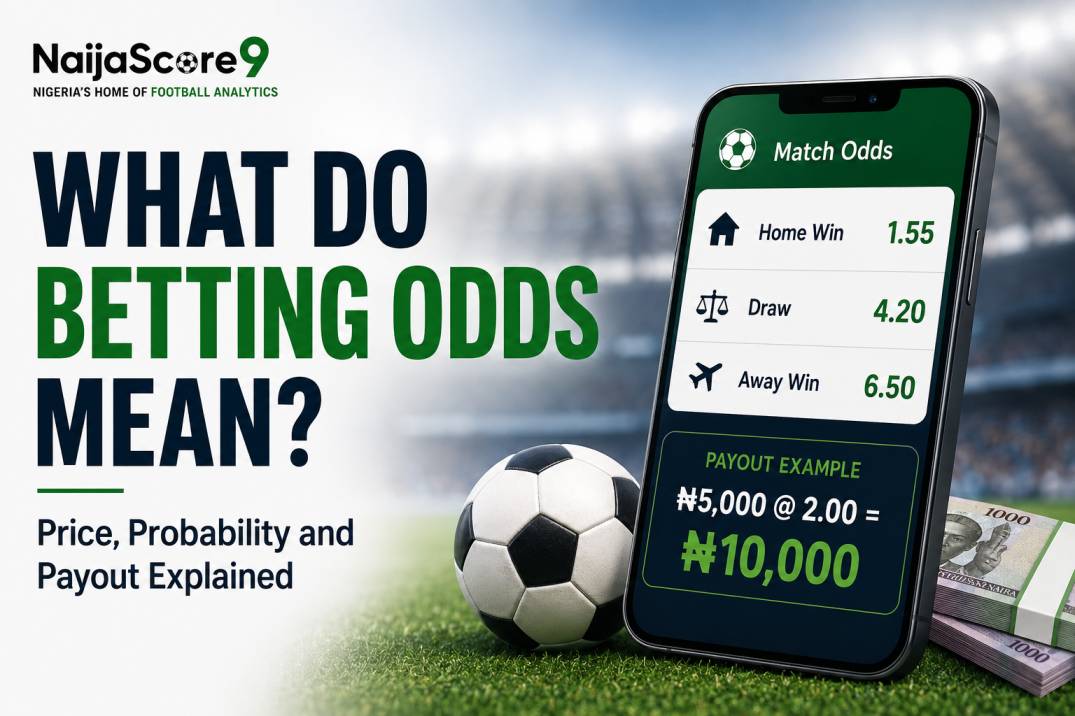
You open a football betting market and see:
Home Win — 1.55
Draw — 4.20
Away Win — 6.50
It is easy to read those numbers only as potential payouts: 6.50 pays more than 1.55, so the away win looks more rewarding.
But betting odds contain more information than that.
They do two important jobs at the same time:
- Odds determine how much a successful bet can return.
- Odds represent a price connected to the estimated probability of the outcome.
That second point is what many beginners miss.
Odds of 1.50 do not mean the selection is “safe.” Odds of 7.00 do not mean the selection is “valuable.” They simply represent different prices for outcomes with different market probabilities.
For football analysis, the useful question is therefore not only:
“How much will this bet pay?”
It is:
“What probability does this price represent, and is that probability reasonable for the outcome I am considering?”
Understanding that relationship makes betting odds much easier to interpret.
Betting Odds Explained in One Example
Suppose Nigeria are playing Team B.
The bookmaker offers:
Nigeria to win — 2.00
You stake:
₦5,000
If Nigeria win:
Total return = ₦5,000 × 2.00 = ₦10,000
That ₦10,000 includes your original ₦5,000 stake.
Your actual profit is:
₦10,000 − ₦5,000 = ₦5,000
At the same time, decimal odds of 2.00 correspond to a raw implied probability of:
1 ÷ 2.00 = 0.50
or:
50%
So the same number—2.00—can be viewed in two ways:
Payout multiplier: 2.00
Raw implied probability: 50%
That is the foundation of understanding betting odds.
What Are Betting Odds?
Betting odds are the price offered on a particular betting outcome.
They tell you how much the sportsbook will return relative to your stake if that outcome wins.
In decimal format:
Potential Return = Stake × Decimal Odds
For example:
| Stake | Odds | Potential Return | Profit |
| ₦1,000 | 1.50 | ₦1,500 | ₦500 |
| ₦1,000 | 2.00 | ₦2,000 | ₦1,000 |
| ₦1,000 | 3.00 | ₦3,000 | ₦2,000 |
| ₦1,000 | 5.00 | ₦5,000 | ₦4,000 |
| ₦1,000 | 10.00 | ₦10,000 | ₦9,000 |
The higher the decimal odds, the larger the potential return for the same stake.
But that does not mean higher odds are automatically better.
Higher odds normally correspond to an outcome the market considers less likely.
Decimal Odds: The Format Nigerian Bettors Usually See
Football sportsbooks commonly display odds in decimal format.
You might see:
1.35
1.80
2.10
4.50
8.00
The calculation is straightforward.
Suppose your bet is:
₦3,000 at odds of 2.50
Potential return:
₦3,000 × 2.50 = ₦7,500
Profit:
₦7,500 − ₦3,000 = ₦4,500
Notice that the displayed return includes the original stake.
This distinction matters because:
return ≠ profit
If your sportsbook says:
Potential Return: ₦7,500
you have not made ₦7,500 profit.
Your ₦3,000 stake is already inside that figure.
How to Calculate Betting Payout?
The basic decimal-odds calculation is:
Potential Return = Stake × Odds
Then:
Potential Profit = Potential Return − Stake
Consider a ₦10,000 stake at odds of 1.75.
Return:
₦10,000 × 1.75 = ₦17,500
Profit:
₦17,500 − ₦10,000 = ₦7,500
Now compare the same stake at odds of 3.00.
Return:
₦10,000 × 3.00 = ₦30,000
Profit:
₦20,000
The second bet pays more because the price is longer.
That bigger payout, however, normally reflects a lower probability of winning.
What Do Low Betting Odds Mean?
Low or short odds indicate that the market prices the outcome as relatively more likely.
For example:
1.20
Raw implied probability:
1 ÷ 1.20 = 83.33%
At odds of 1.20, a ₦5,000 stake gives:
₦6,000 total return
Profit:
₦1,000
The selection has a relatively high market-implied probability, but the reward is correspondingly smaller.
This is the basic trade-off:
Higher estimated probability → usually shorter odds → smaller payout
But 1.20 is still not certainty.
An event with a genuine 83% probability would still fail roughly 17 times in every 100 comparable situations over a very large sample.
That is why describing short-priced football selections as “sure bets” is misleading.
What Do High Betting Odds Mean?
Higher or long odds represent outcomes priced as less likely.
Suppose a team is offered at:
6.00
Raw implied probability:
1 ÷ 6.00 = 16.67%
A ₦5,000 winning stake would return:
₦30,000
Profit:
₦25,000
That large return exists precisely because the selection is less likely to succeed according to the market.
The mistake is assuming:
Large payout = good betting opportunity
Those are different questions.
A selection at 6.00 can still be badly priced if its true probability is lower than the price implies.
This distinction is explored more fully in NaijaScore9’s guide to why high odds do not automatically mean high value.
Betting Odds and Implied Probability
One of the most useful ways to understand betting odds is to convert them into percentages.
For decimal odds:
Raw Implied Probability = 1 ÷ Decimal Odds × 100
Examples:
| Decimal Odds | Raw Implied Probability |
| 1.20 | 83.33% |
| 1.50 | 66.67% |
| 1.80 | 55.56% |
| 2.00 | 50.00% |
| 2.50 | 40.00% |
| 3.00 | 33.33% |
| 4.00 | 25.00% |
| 5.00 | 20.00% |
| 10.00 | 10.00% |
This translation is extremely useful.
Instead of thinking:
“The home team is 1.80.”
you can think:
“This price represents a raw implied probability of approximately 55.6%.”
That makes it easier to compare the bookmaker’s price with your own football analysis.
NaijaScore9’s implied probability calculator can do this conversion directly when you are comparing football prices.
Why Is It Called “Raw” Implied Probability?
Because bookmakers normally include a margin in their prices.
Consider a perfectly balanced hypothetical market:
Team A — 2.00
Team B — 2.00
Each price implies:
50%
Together:
50% + 50% = 100%
There is no theoretical margin in that simplified example.
Now suppose the bookmaker instead offers:
Team A — 1.90
Team B — 1.90
Each implies:
1 ÷ 1.90 = 52.63%
Add them:
52.63% + 52.63% = 105.26%
But the two outcomes cannot genuinely have a combined probability of 105.26%.
The excess above 100% reflects the bookmaker’s pricing margin, often called the overround.
That is why converting one price directly into a percentage gives a raw implied probability, not necessarily the market’s true estimated probability.
A Football 1X2 Example
Consider this hypothetical football market:
Home — 1.80
Draw — 3.80
Away — 5.00
Convert each price.
Home
1 ÷ 1.80 = 55.56%
Draw
1 ÷ 3.80 = 26.32%
Away
1 ÷ 5.00 = 20.00%
Total:
55.56% + 26.32% + 20.00% = 101.88%
The total exceeds 100%.
That difference is evidence of the bookmaker margin embedded in the market.
So it would be inaccurate to say:
“The bookmaker believes the home team has exactly a 55.56% chance.”
The 55.56% is the raw probability represented by the offered price.
To estimate a margin-free market probability, the complete market should be considered.
Odds Are a Price, Not a Prediction
This is one of the most important concepts in betting.
Suppose a bookmaker offers:
Arsenal — 1.60
That is not the bookmaker simply saying:
“Arsenal will win.”
It is offering a price on the event.
Likewise:
Opponent — 6.00
does not mean:
“The opponent has no chance.”
The market is assigning different prices to uncertain outcomes.
A football prediction asks:
How likely is this outcome?
The betting market asks:
What price is being offered for taking that outcome?
Those questions are related but not identical.
This is why NaijaScore9 keeps football predictions and football odds as distinct parts of the analysis process.
Most Likely Does Not Automatically Mean Best Bet
Suppose your analysis gives:
Home win probability: 65%
The home team is clearly your most likely winner.
Fair decimal odds based on that estimate would be:
1 ÷ 0.65 = 1.54
Now suppose the sportsbook offers:
1.35
The available price implies:
74.07%
Your estimate is only:
65%
So the team can still be your most likely winner while the available odds are too short relative to your estimate.
This distinction matters because football users often ask:
“Who will win?”
when the more relevant pricing question is:
“Does the offered price adequately compensate for the probability of losing?”
What Are Fair Odds?
Fair odds are the theoretical decimal price corresponding to your estimated probability before adding a bookmaker margin.
The basic relationship is:
Fair Odds = 1 ÷ Estimated Probability
If your estimated probability is:
50%
Fair odds:
2.00
If your estimate is:
40%
Fair odds:
2.50
If your estimate is:
25%
Fair odds:
4.00
This gives you a benchmark for evaluating a sportsbook’s price.
Suppose you estimate a team’s win probability at:
40%
Your fair price is:
2.50
Bookmaker offers 2.20
That is shorter than your fair estimate.
Bookmaker offers 2.70
That is above your fair estimate.
Under your assumptions, 2.70 would provide the stronger price.
The validity of the conclusion still depends on whether your 40% probability estimate is well calibrated.
What Is a Value Bet?
A value bet is not simply a bet with high odds.
Conceptually, potential value exists when you believe the offered price is higher than the fair price justified by the event’s probability.
Suppose:
Your probability estimate: 50%
Fair odds:
2.00
Available odds:
2.20
The bookmaker is offering a larger return than your own probability estimate would require.
That does not make the selection certain to win.
A 50% event still loses about half the time.
The idea concerns the relationship between price and probability, not the outcome of one match.
For a deeper explanation, read NaijaScore9’s guide to value bets, price, probability and market margin.
A Winning Bet Can Still Have Been a Poor Price
This feels counterintuitive.
Suppose a team has a genuine:
30% probability of winning
Fair odds:
3.33
You accept:
2.50
The team wins.
Your ticket pays.
But that does not prove 2.50 was a good price.
If your 30% estimate was correct, you accepted a return substantially below the theoretical fair price.
Now reverse the example.
Suppose you accept:
3.60
and the team loses.
The result does not automatically mean the price was bad.
One individual outcome cannot tell you whether the underlying probability-price relationship was favourable.
This is why betting analysis should distinguish:
decision quality
from:
one match result.
How Odds Change Before Kick-Off?
Football odds do not necessarily stay at the same price from the moment a market opens until kick-off.
For example:
Monday: Home win 2.30
Friday: Home win 2.10
Before kick-off: Home win 1.95
The market has shortened.
Possible influences include:
- injuries;
- team news;
- expected or confirmed line-ups;
- market activity;
- changes at competing bookmakers;
- changes in perceived probability.
The important point is that the same football outcome can be available at several different prices over time.
That means:
Team A at 2.30
and:
Team A at 1.80
are not financially equivalent decisions.
The football team is the same.
The price is not.
NaijaScore9’s guide to why football odds move before kick-off explains the main reasons these changes occur.
Opening Odds and Closing Odds
Opening odds are the prices available when a market first becomes available.
Closing odds are the final comparable prices shortly before the event starts.
Suppose:
Opening: 2.40
Closing: 2.00
The raw implied probability has changed from:
41.67%
to:
50.00%
That is a meaningful market reassessment.
Closing prices generally have had more opportunity to incorporate:
- late injuries;
- confirmed line-ups;
- additional market participation;
- other information unavailable when the market first opened.
This does not mean closing odds are guaranteed to be correct.
But comparing opening and closing prices can reveal how the market changed its view.
See opening odds vs closing odds for the full comparison.
Why Different Bookmakers Offer Different Odds?
Suppose the same home win is priced:
Bookmaker A — 1.85
Bookmaker B — 1.92
Bookmaker C — 2.00
These are not equivalent.
With a ₦10,000 stake:
At 1.85
Return:
₦18,500
Profit:
₦8,500
At 1.92
Return:
₦19,200
Profit:
₦9,200
At 2.00
Return:
₦20,000
Profit:
₦10,000
The football prediction has not changed.
Only the accepted price has.
That is why comparing odds can matter over a large number of bets.
NaijaScore9’s guide to comparing the same betting market across different bookmakers explains how to make that comparison correctly, including checking that the underlying market rules are actually equivalent.
How Accumulator Odds Work?
Accumulator odds are generally calculated by multiplying the decimal odds of each required selection.
Suppose you combine:
1.50
1.80
2.00
Combined odds:
1.50 × 1.80 × 2.00 = 5.40
Stake:
₦2,000
Potential return:
₦2,000 × 5.40 = ₦10,800
Profit:
₦8,800
The payout is much higher than any individual leg.
But all three active selections normally need to win.
That lower joint probability is why accumulator prices rise rapidly.
If you want to understand how adding selections changes risk and result volatility, see Single Bets vs Accumulators: How Risk and Variance Change.
Does Adding a 1.20 Favourite Make an Accumulator “Safer”?
No.
It may be a relatively likely individual selection, but it still creates another condition that must succeed.
Odds of:
1.20
correspond to a raw implied probability of:
83.33%
That still leaves an implied failure probability of approximately:
16.67%
before considering bookmaker margin.
If you add several short-priced favourites together, the probability that all of them win can decline much more quickly than the ticket initially feels.
For example, five independent selections each with an 80% probability would have a combined probability of:
0.80⁵ = 32.77%
Each individual event is reasonably likely.
The full five-leg result is considerably less likely.
High Odds vs Low Odds: Which Is Better?
Neither.
Odds themselves cannot tell you whether a selection is good.
Compare two examples.
Selection A
Odds:
1.50
Your estimated probability:
60%
Fair odds:
1.67
The offered 1.50 is shorter than your estimate supports.
Selection B
Odds:
4.00
Your estimated probability:
30%
Fair odds:
3.33
The offered 4.00 is above your estimated fair price.
Under those assumptions, Selection B has the more favourable price even though it is less likely to win.
That is why the question:
“Are high or low odds better?”
has no useful answer without probability.
Why a 90% Win Rate Can Still Be Poor Betting?
Suppose you place ten ₦10,000 bets at:
1.05
Nine win.
One loses.
Nine winners
Profit per winner:
₦500
Total profit:
₦4,500
One loser
Loss:
₦10,000
Net result:
−₦5,500
You won:
9 out of 10 bets
or:
90%
and still lost money.
This demonstrates why strike rate alone does not determine profitability.
The odds attached to wins matter just as much.
Why a Low Win Rate Can Still Be Profitable?
Now imagine ten equal stakes at odds of:
4.00
You win three and lose seven.
Each ₦1,000 winning selection produces:
₦4,000 return
or:
₦3,000 profit
Three wins:
₦9,000 profit
Seven losing stakes:
−₦7,000
Net:
+₦2,000
Win rate:
30%
Yet the record is profitable.
This is another reason betting odds should be understood as a relationship between:
probability + payout
rather than simply the frequency of winning selections.
What Happens to the Odds if a Bet Is Void?
In an ordinary single cash wager, a void normally means the stake is returned.
In a standard accumulator, the void selection is commonly removed or treated neutrally, often equivalent to odds of:
1.00
Suppose your accumulator contains:
1.80 × 2.00 × 1.70
Original odds:
6.12
If the 2.00 selection becomes void:
1.80 × 1.00 × 1.70 = 3.06
The remaining selections can still win, but the potential payout decreases.
NaijaScore9’s guide to what a void bet means explains the settlement in more detail.
Odds Do Not Tell You the Maximum Possible Outcome of a Match
A common misunderstanding is to treat bookmaker odds as an exact prediction.
For example:
Home 1.50
Draw 4.50
Away 7.00
This does not mean the bookmaker believes:
Home will definitely win.
It means the home outcome has been assigned the shortest price of the three.
All three outcomes remain possible.
Similarly, correct-score odds such as:
2–1 @ 9.00
do not mean 2–1 is expected with certainty.
It is simply a price on that exact result.
Betting Odds vs Probability: A Practical Football Example
Suppose your analysis of a fixture produces:
| Outcome | Your Estimated Probability | Your Fair Odds |
| Home | 52% | 1.92 |
| Draw | 28% | 3.57 |
| Away | 20% | 5.00 |
The bookmaker offers:
| Outcome | Available Odds |
| Home | 1.75 |
| Draw | 3.80 |
| Away | 5.50 |
Now compare.
Home
Your fair odds:
1.92
Market:
1.75
Available price is shorter than your estimate.
Draw
Your fair odds:
3.57
Market:
3.80
Available price is slightly higher.
Away
Your fair odds:
5.00
Market:
5.50
Again, the available price is above your estimated fair price.
This example demonstrates why the shortest-priced outcome is not automatically the most interesting from a pricing perspective.
Your football probability assessment and the bookmaker’s price must be compared.
The Most Useful Way to Read Football Odds
Instead of looking at a market like this:
Home — 1.70
Draw — 4.00
Away — 5.00
and immediately choosing the lowest number, use this sequence.
Step 1: Identify the Exact Market
Is it:
- 90-minute match result;
- Draw No Bet;
- Double Chance;
- Asian Handicap;
- Over/Under Goals;
- Anytime Goalscorer?
Odds cannot be compared properly when the contracts differ.
Step 2: Convert the Price Into Probability
For decimal odds:
1 ÷ odds × 100
Step 3: Consider the Bookmaker Margin
The raw percentage is not automatically a fair probability.
Look at the full market where possible.
Step 4: Make Your Own Football Assessment
Consider relevant information such as:
- team strength;
- expected goals;
- home/away performance;
- player availability;
- expected line-ups;
- fixture congestion;
- tactical match-up.
Step 5: Estimate Your Probability
Do not use labels such as:
“Very confident.”
Try to quantify the forecast.
Step 6: Compare Probability With Price
Ask whether the odds compensate adequately for the chance of losing.
Step 7: Compare Bookmakers
A good analysis can still become a worse financial decision if you consistently accept a weaker available price.
Common Mistakes When Reading Betting Odds
Thinking 1.20 Means Guaranteed
It does not.
Short odds still lose.
Thinking 10.00 Is Automatically Good Value
A large potential payout can still be badly priced.
Confusing Return With Profit
Your original stake is normally included in the displayed decimal return.
Ignoring the Bookmaker Margin
Raw implied probabilities can add to more than 100%.
Choosing the Favourite Without Assessing the Price
The most likely winner and the best price are separate questions.
Ignoring Differences Between Bookmakers
1.80 and 1.95 on the same outcome can produce meaningfully different long-term returns.
Adding Short Odds to an Accumulator Because They Look “Safe”
Every added selection creates another failure point.
Judging Price From the Result
A winning bet can have been taken at a poor price, and a losing bet can have been taken at a reasonable price.
Conclusion
The easiest way to misunderstand betting odds is to look only at the money you could win.
Odds of 5.00 certainly offer a larger potential return than odds of 1.50.
But the larger return exists because the underlying outcome is priced as less likely.
That is why betting odds should always be read in two ways:
as a payout multiplier
and:
as a price connected to probability.
If you stake ₦5,000 at 2.00, the potential total return is ₦10,000. At the same time, the price represents a raw implied probability of 50%.
Once you understand those two meanings, several common betting mistakes become easier to avoid.
A short-priced favourite is not automatically safe.
A long-priced underdog is not automatically valuable.
A high strike rate does not automatically produce profit.
And the biggest potential payout is not automatically the strongest decision.
For football analysis, the more useful process is:
Understand the market → convert the odds into probability → assess the match independently → compare your probability with the available price → compare equivalent prices across bookmakers.
That is the real purpose of betting odds.
They do not tell you what will definitely happen.
They tell you what price is available if you are willing to take a particular uncertain outcome.
Once price and probability are separated from prediction confidence, football betting markets become much easier to evaluate clearly.