
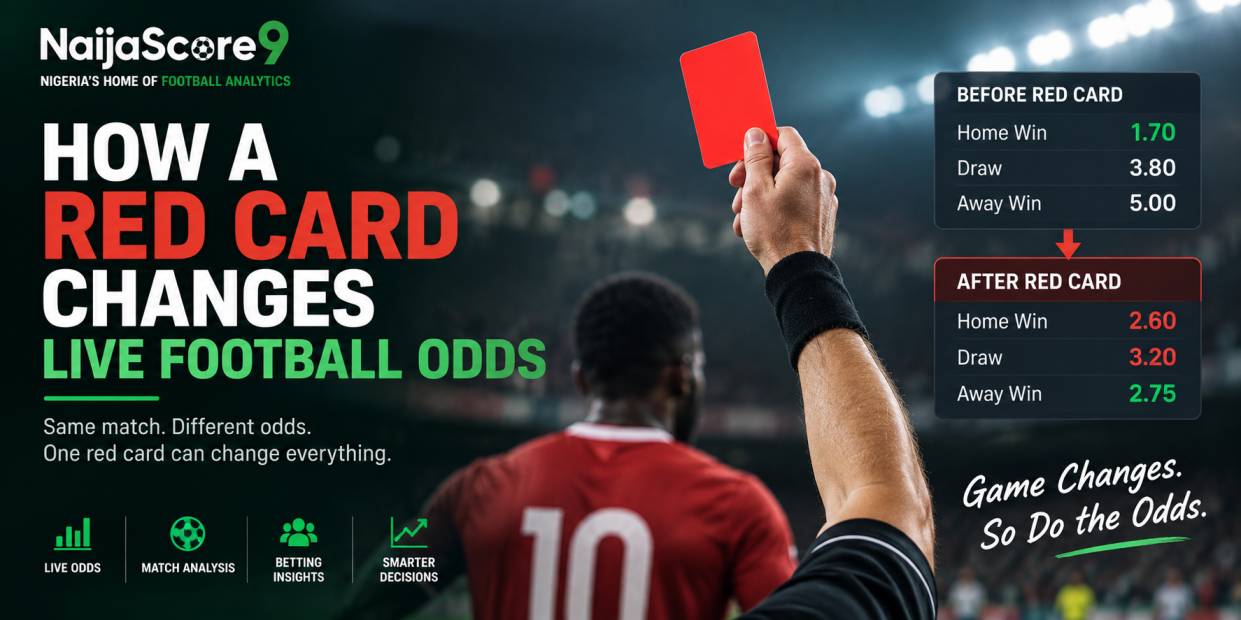
A favourite is leading 1–0 after 35 minutes. Its live win price is 1.45.
Then one of its defenders is sent off.
Within moments, the same team’s price may move to 1.80, 2.10 or considerably higher. The opponent’s odds shorten, the draw becomes more relevant, goal-market prices change and an available cash-out value can fall almost immediately.
The sportsbook has not simply applied a fixed “red card penalty.”
It has recalculated the remaining match.
A player sent off after kick-off cannot be replaced under IFAB’s Laws of the Game, meaning the affected team normally continues with one fewer player. That numerical disadvantage changes expected attacking output, defensive resistance, territory, substitutions and tactical behaviour—all of which can affect the probability of the remaining outcomes.
Research supports the underlying effect. A study modelling Premier League and Championship matches found that a red card increased the goal rate of the non-penalised team. Separate research on World Cup matches found a substantial reduction in the scoring and winning prospects of teams receiving a red card, while later work on UEFA club competitions showed that the effect also depends on factors such as which team is dismissed and when the dismissal happens.
For anyone trying to understand the red card effect on live betting odds, the crucial principle is:
The market does not price the red card alone. It replaces the entire match state after the red card.
That match state includes the score, time remaining, strength of the teams, position of the dismissed player and how both sides are likely to adapt.
What Happens to Live Betting Odds After a Red Card?
In the simplest case, assume the teams are level and one side receives a red card.
The typical directional reaction is:
| Market | Team With 10 Players | Team With 11 Players |
| Match win | Odds usually lengthen | Odds usually shorten |
| Draw | Depends heavily on score/time | Depends heavily on score/time |
| Team to score next | Usually lengthens | Usually shortens |
| Team goal line | Often shifts downward | Often shifts upward |
| Handicap | Moves against 10-man team | Moves toward 11-man team |
| Clean sheet | Becomes harder | Becomes more likely |
| Cash-out value on 10-man team | Often falls | Usually rises for opposite positions |
These are directions, not fixed rules.
A red card to a team leading 3–0 after 84 minutes will not produce the same repricing as a red card at 0–0 after 18 minutes.
The event is identical.
Its effect on the remaining probability is not.
Why Does a Red Card Move the Odds So Quickly?
Sportsbook prices are built around probabilities.
Before the sending-off, the market may estimate:
Home win: 54%
Draw: 27%
Away win: 19%
A red card to the home side changes the information available.
The market now needs to estimate the remaining game with:
- fewer home players;
- different attacking capability;
- different defensive capability;
- possible tactical substitutions;
- a different expected pattern of possession and territory.
A revised assessment might become:
Home win: 37%
Draw: 32%
Away win: 31%
Those percentages are only illustrative, but they demonstrate what the odds movement represents.
The sportsbook is effectively saying:
“The probability distribution we had 20 seconds ago is no longer appropriate.”
If you need the basic relationship between market price and probability first, see NaijaScore9’s guide to how betting odds reflect probability.
The Timing of the Red Card Matters Enormously
A red card in the 12th minute creates almost an entire match of numerical disadvantage.
A red card in the 89th minute may leave only a few minutes plus stoppage time.
The market therefore cares about how long the numerical advantage is expected to exist.
Consider the same match:
Score: 0–0
Red Card in Minute 15
Approximately 75+ minutes remain.
The team with 10 players must potentially:
- defend longer;
- cover more space;
- make tactical compromises;
- attack with fewer numbers;
- absorb more possession.
The price adjustment can be substantial.
Red Card in Minute 82
Only a relatively short period remains.
There is much less time for the 11-man side to convert its numerical advantage into goals.
The repricing should generally be smaller.
Historical data also shows why timing cannot be ignored. A large observational study of nearly 20,000 matches found that teams receiving early red cards had materially worse eventual results than teams dismissed much later, although such descriptive data should not be treated as a universal pricing formula.
The Practical Rule
Earlier red card = more remaining exposure to playing with 10 men.
But timing is only the first adjustment.
The current score can matter even more.
Scoreline + Red Card: The Combination the Market Actually Prices
Consider four very different situations.
Scenario A: 0–0, 25th Minute
Home team receives a red card.
The away team’s win probability can rise significantly because:
- the score is level;
- most of the match remains;
- the away team has time to exploit the extra player.
Scenario B: Home Team Leads 1–0, 25th Minute
The red card still hurts the home team.
But it already owns a one-goal advantage.
The away team’s probability improves, yet the home side may still retain a meaningful chance of protecting the lead.
Scenario C: Home Team Leads 2–0, 70th Minute
The card is important.
But two goals and limited remaining time provide substantial protection.
The favourite’s odds will usually drift, but that does not mean the opponent suddenly becomes the most likely winner.
Scenario D: Home Team Trails 0–1, 70th Minute
Now the dismissal is particularly damaging.
The home team already needs to score and must chase the match with one fewer player.
Its win odds can move sharply outward because it now needs to overturn:
both the score disadvantage and the numerical disadvantage.
This is why the statement:
“A red card changes the odds by X%”
is not useful.
There is no universal X.
Why the Team Receiving the Red Card Matters?
Suppose a heavy pre-match favourite is playing a major underdog.
Before kick-off:
Favourite: 1.35
Draw: 5.20
Underdog: 9.00
At 0–0, the favourite receives a red card after 20 minutes.
The favourite’s win probability falls sharply.
But it does not automatically become the underdog.
Its remaining 10 players may still be individually stronger than the opponent’s 11.
Now reverse the dismissal.
If the 9.00 underdog goes down to 10 men, its already-low win probability can fall much further.
The effect therefore depends partly on the strength difference that existed before the card.
Research examining UEFA Champions League and Europa League games reinforces the importance of context: the effect of dismissal was not identical across home and away teams and varied with timing.
A live model should update an existing strength assessment rather than pretend both teams were equal before the incident.
Does the Position of the Sent-Off Player Matter?
Yes, although numerical disadvantage is normally the largest immediate factor.
Losing a:
centre-back
does not create exactly the same tactical problem as losing a:
striker.
Centre-Back Sent Off
The manager may need to:
- remove an attacker;
- introduce another defender;
- change from a back four to a compact structure;
- concede attacking presence.
The dismissal can therefore indirectly weaken both attack and defence.
Central Midfielder Sent Off
The side may struggle to:
- control midfield;
- press;
- protect central spaces;
- progress possession.
Winger Sent Off
The defensive structure may be easier to repair, but:
- counter-attacking outlets can disappear;
- full-back protection can weaken;
- attacking width can be reduced.
Striker Sent Off
The team can often preserve a relatively coherent defensive structure but may lose:
- pressing from the front;
- hold-up play;
- transition threat;
- an outlet for clearances.
Goalkeeper Sent Off
This creates an additional structural complication.
A substitute goalkeeper may need to enter, requiring an outfield player to be withdrawn if substitutions remain.
The market therefore cares not merely about:
11 vs 10
but also about:
which tactical functions disappeared with the player.
That connects directly with how tactical matchups change football probabilities.
What Happens to Match-Winner Odds?
The 1X2 market usually provides the clearest immediate reaction.
Suppose before the dismissal:
Home: 1.80
Draw: 3.80
Away: 5.00
The home team receives a red card at 0–0 after 30 minutes.
A hypothetical new market might become:
Home: 2.60
Draw: 3.20
Away: 3.10
The exact numbers depend on the match.
But the mechanics are clear:
- home win becomes less probable → home odds lengthen;
- away win becomes more probable → away odds shorten;
- draw is repriced according to the new expected game state.
The draw is particularly interesting because its movement is not always obvious.
Why Draw Odds Can Move in Either Direction?
Suppose a strong favourite receives a red card while the match is level.
Before the card, the market expects the favourite to win.
After the card, its attacking superiority is reduced and the weaker side becomes more competitive.
That can make the draw more likely, causing draw odds to shorten.
But consider another situation.
The 10-man team is already trailing late in the match.
It must attack despite being numerically disadvantaged.
That can increase the probability of:
- an equaliser;
- or another opposition goal.
Depending on the exact score and time, the draw can move differently.
There is therefore no useful rule that says:
“Red card = always back the draw.”
The score state determines whether the draw becomes more or less plausible.
How a Red Card Affects Over/Under Goals Markets?
Many users assume a red card automatically means:
more goals.
That is too simplistic.
The team with 11 players may create more chances, but the team with 10 may become much more defensive.
The resulting total-goals effect depends on how those two forces interact.
Why Over Odds May Shorten?
A dismissal can create:
- more space;
- defensive overloads;
- fatigue;
- higher-quality chances for the 11-man team;
- dangerous transitions if the 10-man team must chase.
Research has found that a red card can increase the scoring rate of the non-penalised team.
Why the Match Can Still Become Lower-Event?
Suppose the 10-man team is protecting a 1–0 lead.
It may immediately switch to:
5-3-1
or another compact defensive shape.
It may:
- stop pressing high;
- concede possession;
- reduce attacking numbers;
- slow the match when possible.
The 11-man side may dominate possession without immediately producing high-quality chances.
So the correct question is not:
“Does a red card mean Over?”
It is:
“How does the dismissal change each team’s expected scoring rate from this score and time?”
How a Red Card Changes BTTS Probability?
The effect on Both Teams to Score can also move in either direction.
Example: 0–0, Favourite Receives a Red Card
The underdog’s chance of scoring can rise.
But the favourite’s own scoring probability may fall.
Those effects pull BTTS in opposite directions.
Example: 1–0, Trailing Team Receives a Red Card
BTTS Yes can become less likely because the team that still needs its first goal now has fewer players.
Example: 0–1, Leading Team Receives a Red Card
BTTS Yes may become more likely because the trailing side now has a numerical advantage while still needing to score.
Again, the card itself does not determine the market.
The new scoring paths do.
How Red Cards Affect Asian Handicap and Spread Markets?
Handicap markets often move sharply because a sending-off directly changes the perceived balance between the teams.
Suppose before the card:
Team A -0.5
Team A then loses a player at 0–0.
The market might move toward:
Team A +0.25
or another materially different handicap depending on time and team strength.
This reflects the same repricing that occurs in 1X2, but expressed through a handicap line instead of simple winner prices.
If the stronger team receives the dismissal, its expected superiority may disappear or shrink.
If the weaker team receives it, the handicap can move further toward the favourite.
How a Red Card Can Change Next-Goal Odds?
Next-goal markets react particularly directly to numerical advantage.
At 11 vs 11:
Team A next goal: 2.00
No next goal: 4.50
Team B next goal: 3.20
Team B receives a red card.
The revised market might move toward:
Team A next goal: 1.60
while Team B’s price becomes considerably longer.
This happens because the sportsbook now expects Team A to create a larger share of the remaining scoring opportunities.
But team strength and tactics remain important.
A 10-man elite side can still carry more attacking threat than an 11-man weak opponent.
Do Red Cards Change Expected Goals?
They change the expected future chance environment.
This is different from rewriting xG that has already been recorded.
Suppose before the red card:
Team A: 0.70 xG
Team B: 0.50 xG
Those historical values remain.
But once Team B loses a player, the expected rate of future chance creation changes.
A recent study using minute-level data across the five major European leagues found strong effects associated with playing one player up or down when adjusting xG and shots on target for game context.
For analysis, keep these two ideas separate:
xG already created = evidence about the match so far.
Expected xG after the dismissal = a new forecast under a different game state.
For a fuller explanation of how chance quality should be interpreted, see expected goals in football analysis.
Why a Red Card Does Not Make 10 Men Automatically Poor
A common live-betting mistake is assuming:
10 men = team will collapse.
Football is more complicated.
After the red card, a team can become:
- more compact;
- more conservative;
- harder to play through;
- focused on counter-attacks.
Suppose a technically superior team leads 1–0 and goes down to 10 men after 65 minutes.
It may still have:
- excellent defenders;
- a strong goalkeeper;
- enough pace to counter;
- a one-goal advantage.
Its win probability decreases, but it can remain substantial.
The correct interpretation is:
the red card changes the probability—not the result.
Why Some 10-Man Teams Still Score?
Being a player down reduces attacking capacity on average, but does not remove it.
A 10-man team can still score through:
- counter-attacks;
- set pieces;
- defensive errors;
- penalties;
- individual quality.
The 11-man team can also become more aggressive, pushing additional players forward and leaving counter-attacking space.
This becomes especially important when the team with 10 players is already losing.
It cannot simply defend.
It may eventually need to accept more risk, producing a highly open final period.
Tactical Reaction Matters Almost as Much as the Card
Two managers can respond very differently to the same dismissal.
Manager A
Immediately removes an attacker and builds a compact:
4-4-1
The objective becomes:
protect the current score.
Manager B
Keeps two attacking outlets and accepts greater defensive risk.
The match remains open.
The same red card therefore produces different expected scoring patterns.
Watch for:
- immediate substitution;
- formation change;
- defensive line;
- pressing intensity;
- counter-attacking outlet;
- which side controls territory after the restart.
The first several minutes after the sending-off can reveal how each manager intends to handle the new match state.
Do Not Assume the Market Reacts Perfectly in One Instant
Modern in-play markets update very quickly.
But immediately after a major event, the sportsbook may:
- suspend the market;
- verify the red card;
- await VAR confirmation;
- reprice;
- reopen markets.
Prices can then continue adjusting as the new tactical structure becomes visible.
For example:
Red card shown → market suspended → VAR review → red card confirmed → market reopened
The first available price after reopening does not guarantee that it will remain there.
Substitutions, tactical changes and market activity can continue moving it.
VAR Can Create Temporary Pricing Uncertainty
A red-card decision can be reviewed.
Until the decision is confirmed, sportsbooks may suspend affected in-play markets.
This matters because placing a wager based on a television image while assuming the market has already fully processed the incident can be misleading.
There may also be differences in broadcast delay.
The bookmaker’s data feed may receive the incident before your stream shows it.
Trying to beat the market using a delayed video feed is therefore not a reliable edge.
What Happens to Cash-Out Value After a Red Card?
A red card can immediately change the value of an open position because the probability of the underlying selection has changed.
Suppose:
Original bet: Home Win
The home team is leading and your cash-out value has risen.
Then the home team receives a red card.
Its live win price moves outward.
Your cash-out value may fall because the sportsbook now values the original ticket less favourably.
The opposite can also occur.
If you backed the away team and the home side receives the red card, your cash-out offer can rise sharply.
NaijaScore9’s guide to how cash-out offers are calculated explains how current market prices feed into that valuation.
Should You Immediately Cash Out After a Red Card?
Not automatically.
Cash Out is itself a price.
Suppose:
Potential return: ₦20,000
After the red card:
Cash Out: ₦9,500
The decision should not be:
“A red card happened, so cash out.”
Instead ask:
- Which team received the card?
- What is the score?
- How much time remains?
- What does the new live price imply?
- Has the sportsbook already heavily adjusted the offer?
- Do I still agree with the updated probability?
The red card is information.
The cash-out offer is the bookmaker’s price for taking your remaining position.
Those are two separate things.
Can You Hedge After a Red Card?
Potentially, but the same caution applies.
Suppose your original position becomes riskier after a sending-off.
A complementary wager could reduce that exposure.
However, by the time the market reopens, the red card will usually already be reflected in the new odds.
You are not receiving pre-red-card prices.
Therefore, hedging should be based on the new probability and new price, not on the assumption that the second bet is automatically attractive because circumstances changed.
For the mechanics, see how to hedge a bet.
A Worked Example: Favourite Gets a Red Card at 0–0
Consider a fictional match.
Before Kick-Off
Home:
1.65
Draw:
3.90
Away:
5.50
The home team is a clear favourite.
30th Minute
Score:
0–0
No major events.
Live prices:
Home 1.85
Draw 3.30
Away 4.80
Now the home team receives a red card.
After Repricing
Hypothetical market:
Home 2.90
Draw 3.15
Away 2.75
What happened?
The home side moved from:
clear favourite
to:
roughly competitive with the away side.
But it did not automatically become a massive underdog because:
- the score remains level;
- the original home team was substantially stronger;
- 10 strong players may still compete effectively against this opponent.
The red card modified the baseline.
It did not erase everything known before the match.
Worked Example: Underdog Gets a Red Card While Trailing
Pre-match:
Favourite 1.40
Draw 4.80
Underdog 8.00
At minute 55:
Favourite leads 1–0
Then the underdog receives a red card.
The underdog now has:
- a one-goal deficit;
- one fewer player;
- only around 35 minutes plus stoppage time.
Its win probability becomes extremely small.
The favourite’s live odds can shorten sharply because several pieces of evidence now point in the same direction:
stronger team + current lead + numerical advantage + less time remaining.
This illustrates why some red cards produce much larger market movements than others.
Worked Example: Leading Underdog Receives a Late Red Card
Now consider:
Underdog leads 1–0
at:
80 minutes
and receives a red card.
The favourite’s probability of scoring increases.
But only a limited amount of time remains.
The three possible outcomes still need to be separated:
- underdog holds on;
- favourite equalises;
- favourite scores twice and wins.
A red card can make the equaliser considerably more likely without making a full comeback the most likely individual outcome.
This distinction is important when evaluating:
- match winner;
- draw;
- next goal;
- Double Chance;
- goal totals.
Why Red Cards Can Affect Different Markets Unequally?
A single incident can move several markets, but not by the same amount.
Suppose the leading team receives a red card after 70 minutes.
Match-Winner Market
Its win probability falls.
Next-Goal Market
Opponent may become a strong favourite to score next.
Over 3.5 Goals
May change only moderately if the current score is still low and time is limited.
BTTS
Can move strongly if one team has not yet scored.
Correct Score
Several scorelines may reprice dramatically.
Corners
The 11-man team may now dominate territory, potentially changing expected corner volume.
The lesson is:
Do not treat “the red card effect” as one universal adjustment across every market.
Each market asks a different question.
A Better Way to Read Live Odds After a Red Card
Use this sequence rather than reacting to the card alone.
1. Confirm Who Was Actually Sent Off
Was it:
- an on-field player;
- substitute;
- substituted player;
- coach?
This matters.
Under IFAB Law 3, an on-field player sent off after kick-off cannot be replaced. A substitute or team official receiving a red card does not create the same 10-v-11 situation.
That distinction is critical.
2. Check the Score
Ask:
Who currently needs to change the match?
A 10-man team protecting a lead behaves differently from a 10-man team chasing one.
3. Check the Minute
Estimate how long the numerical advantage will matter.
4. Reconsider Baseline Team Strength
Do not forget everything known pre-match.
5. Identify the Player Lost
Determine which tactical functions disappear.
6. Watch the Immediate Tactical Adjustment
Look for:
- substitution;
- formation;
- defensive block;
- attacking outlet.
7. Reassess Expected Scoring
Whose chance creation rises?
Whose falls?
8. Only Then Interpret the New Price
The odds are the market’s updated response to all those factors.
Red Card Before Kick-Off vs Red Card During the Match
These situations should not be confused.
IFAB states that a player sent off after being named on the team list but before kick-off may be replaced by a named substitute. By contrast, a player sent off after kick-off cannot be replaced.
Therefore:
Pre-Match Sending-Off
Does not necessarily mean the team begins with 10 players.
In-Match Sending-Off
Normally creates the meaningful numerical disadvantage relevant to live pricing.
For this article, the important event is therefore an on-field dismissal after kick-off.
What if Both Teams Receive Red Cards?
If both teams lose one player, the original numerical advantage can disappear.
For example:
10 vs 10
is structurally different from:
10 vs 11.
However, this does not necessarily restore the original pre-red-card probabilities.
The game now has:
- fewer total players;
- potentially more space;
- different substitutions;
- changed tactical structures.
The identities and timing of the dismissals still matter.
If one team played 20 minutes with an advantage before losing its own player, the current score may already reflect that period.
What if a Second Player Is Sent Off From the Same Team?
Now the numerical imbalance becomes:
9 vs 11.
The consequences can be much larger.
The team with nine players may have to sacrifice almost all attacking ambition simply to preserve defensive structure.
IFAB’s current Laws state that a match may not continue if a team has fewer than seven players, subject to specified protocol exceptions.
For pricing purposes, every additional dismissal creates a new game state requiring another probability update.
Conclusion
The most useful way to understand a red card in live football markets is not:
“Ten men are worse than eleven.”
That is true, but it is not enough.
A sportsbook has to determine what playing with 10 men means from this exact point in this exact match.
A red card at 0–0 after 15 minutes can transform the expected result because the numerical disadvantage may last for most of the game.
The same card at 2–0 after 88 minutes has far less time to alter the outcome.
A dismissal to a struggling underdog is different from a dismissal to an elite favourite. Losing a centre-back can force one tactical response; losing a striker can produce another. A team protecting a lead can retreat into a compact block, while a team already behind may eventually have to attack with even greater risk.
That is why good analysis after a red card should follow this order:
Who received the card → current score → match minute → baseline team strength → player/position lost → tactical response → new expected scoring rates → updated market price.
The red card itself is only the trigger.
The value lies in understanding everything that changes after it.
Research consistently supports the broad direction of the effect: playing a man down can reduce the dismissed team’s scoring and winning prospects while increasing opportunities for the opponent. But those findings should inform the probability adjustment rather than become a simplistic rule that every 11-man team must win.
For live analysis, the most important distinction is therefore:
A red card is powerful information, but by the time the market reopens, it is also information the sportsbook is already pricing.
Do not ask only whether the card helps one team.
Ask whether the new price accurately reflects how much it helps them.
That is the difference between reacting to an incident and actually understanding the odds movement.